
Torsion & extension springs · Arlington Heights, IL
Broken Garage Door Spring Repair in Arlington Heights
It nearly always happens at the end of a cycle, and it sounds like a gunshot somewhere in the house. Then the door will not lift, or the opener strains and quits. That is a broken garage door spring, and it is the one fault we would rather you left alone until we arrive.
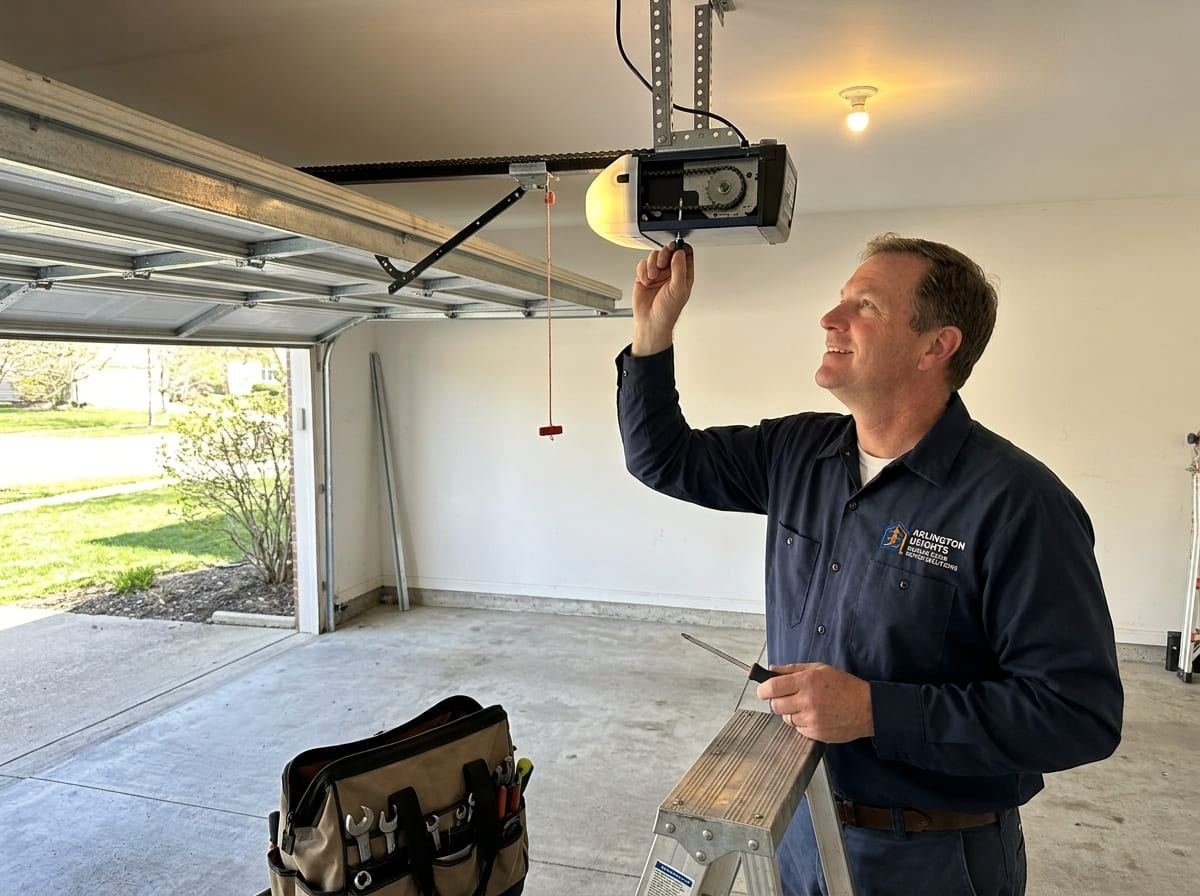
Torsion or extension: which is above your door?
You can tell from the floor without touching anything, and it changes the repair.
- Torsion
- One or two springs mounted horizontally on a steel shaft above the opening, usually on a center bearing plate, with cables running from the bottom brackets to drums at each end. Most Arlington Heights doors from the late 1970s on use this.
- Extension
- A long spring parallel to each horizontal track, stretching and relaxing as the door moves, hooked to a pulley. Common on older, lighter doors and still found across the 1950s and 1960s garages of south Arlington Heights.
A broken torsion spring shows a clean two-inch gap in the coil. A broken extension spring hangs loose, and with no safety cable through it, part of it may be on the floor.
What the bang actually was
A torsion spring is hardened steel wire wound tight enough to store the whole weight of your door as torque. Every cycle flexes it. Over tens of thousands of cycles the steel fatigues, a crack starts at a defect, runs across the wire, and the spring lets go in a fraction of a second. The stored energy releases at once against the shaft, and that is the noise.
Nothing you did caused it. It is a wear component reaching the end of its life, the way a tire reaches the end of its tread.
Why the door now weighs everything it weighs
The spring is not there to help the opener. It is a counterbalance, sized to offset the door’s mass so the assembly sits close to neutral through its travel. Remove it and you hold the raw weight: a double steel sectional commonly runs 150 to 250 lb, and an insulated 16 × 7 sits near the top of that.
Do not run the opener
A residential opener overcomes friction on a balanced door. It does not lift a quarter of a ton. Ask it to and you strip the nylon drive gear, shear the trolley or pull the bracket out of the header. Spring jobs arrive as spring-and-opener jobs because somebody pressed the button four more times to be sure. Unplug it.
Lifting by hand is no better. People strain backs and trap fingers between sections doing it, and a door that gets away on the way down takes the cables, drums and bottom section with it.
Why we replace springs in matched pairs
On a two-spring door both springs were wound the same day, sized to the same door, and have cycled together ever since. When one fails the other has done identical work. Replacing a single spring buys you a second call-out within months, plus a second labor charge.
The mechanics agree. A new spring paired with a tired one loads the shaft unevenly, so the door lifts out of level, cables wear at different rates and drums drift. DASMA’s consumer safety guidance is unambiguous: replace both springs when one breaks. We do it as standard, not as an upsell.
Cycle life, stated accurately
A great deal of nonsense is published about spring ratings. Here is what the standards say.
A cycle has a formal definition. Under ANSI/DASMA 109, one cycle starts closed, moves to open, and returns to closed. Up and back down, not each individual movement.
What it does not do is mandate a minimum. It is a test method; the target rating is set by the manufacturer. Any company telling you DASMA requires 10,000 cycles is repeating a competitor’s blog. For years rather than cycles, HomeAdvisor estimates torsion springs at 10,000 to 20,000 cycles, about 8 to 15 years, and extension springs at 7 to 12. A guide, not a warranty.
Your mileage depends on use. Two cycles a day is a spring that lasts; eight is a much shorter clock.
High-cycle springs, and who they suit
A high-cycle spring uses larger wire and more coils over a longer length, achieving the same lift at lower stress per cycle. It costs more and is not right for every door. It earns its money in the household whose garage door is really the front door.
That is common here. Department of Energy figures from the 2017 American Housing Survey put garages or carports on 66% of occupied U.S. housing units, and 75% or more across the Midwest. A Harris Interactive survey for Amarr, reported by DASMA, found 45% of homeowners with a garage use that door as their main way in. Four or five round trips a day burns through a standard spring’s rating in a few years.
What actually shortens a spring’s life
DASMA publishes a technical data sheet on exactly this. TDS #190, Factors Affecting Spring Cycle Life, names the culprits:
- Rust, which reduces the effective cross-sectional area of the wire. Less steel, less strength at the same load.
- Corrosion pits, which DASMA says fatigue cracks accelerate from. A pit is a stress raiser, and that is where the crack starts.
- Nicks and notches from a spring being dropped, thrown or dragged before it was ever fitted.
- Extreme climates and saline environments, along with corrosive chemicals, which cause premature failure.
- Improper torque, leaving the spring overstressed or the door unbalanced.
- Poor lubrication of the counterbalance assembly.
DASMA also notes spring cycle life may not coincide with door cycle life. A door outlasting its springs twice over is normal.
Cook County winters and counterbalance hardware
Read that list again with an Illinois January in mind. O’Hare’s January mean is 25.2 °F, the Great Lakes region averages around 42 freeze–thaw cycles a year, and every arterial near you is salted from the first two inches of snow. Chloride-laden meltwater comes off your tires and dries on cold steel. Salt is hygroscopic, so it pulls moisture back out of the air and keeps that surface damp: the rust and pitting mechanism DASMA describes, running all winter.
It is why our spring calls cluster in December, January and February. The full mechanism is in why garage door springs break in Chicago winters, and the chemistry in what road salt does to garage door hardware.
The job that injures people
We are not being dramatic to win work. A torsion spring holds around thirty turns of stored energy, released with two winding bars in a specific order. Get the sequence wrong, or reach for a screwdriver because it was to hand, and the bar leaves the cone at speed with your hands and face in its path.
The rest is just as real: the shaft can spin, the drums can slip, the door can drop. Extension springs add their own problem, because one that fails without a safety cable through it becomes a projectile down the garage. No safety cables on yours? Worth fixing whether or not anything is broken today.
DASMA discourages DIY spring work outright. So do we, and we say it while quoting a job we would rather you gave to somebody competent than attempted.
On the day
How the replacement goes
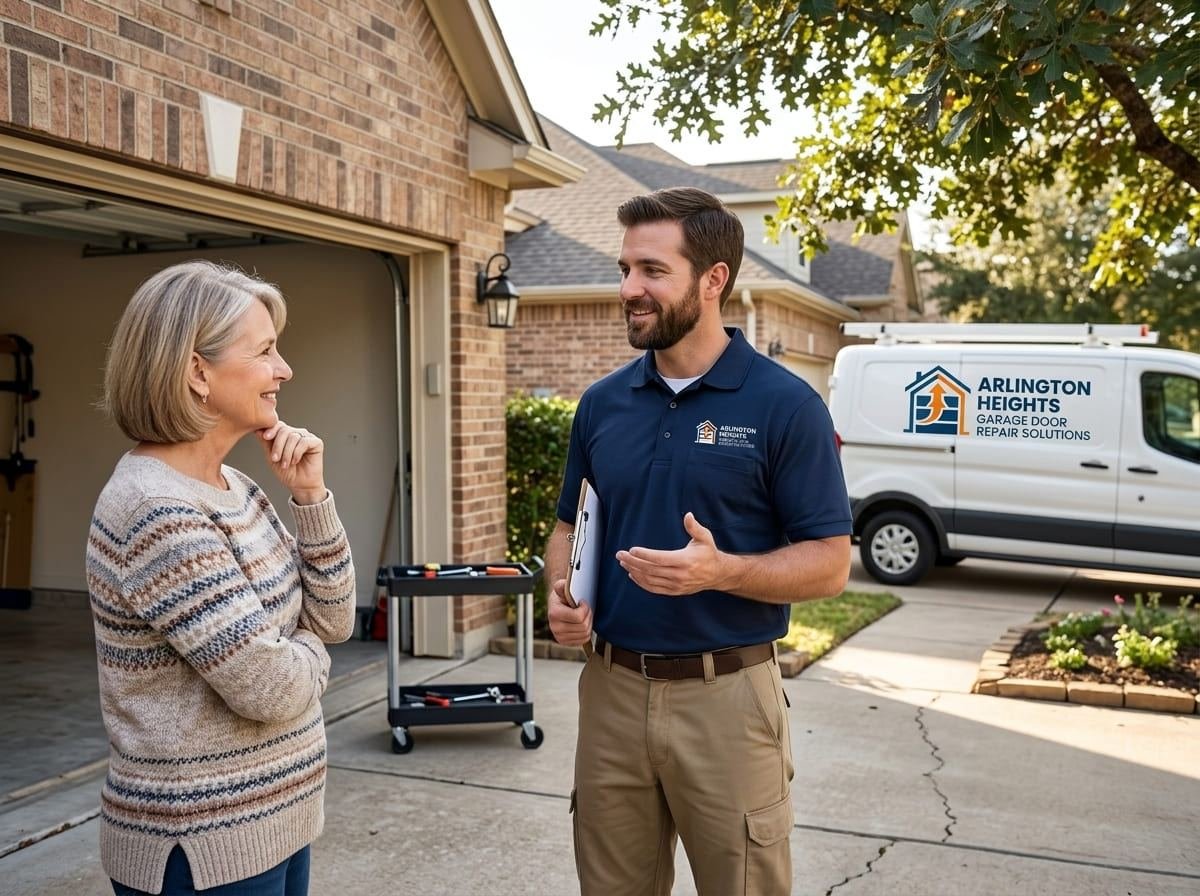
We measure the failed spring rather than eyeballing it: wire diameter, inside diameter, overall length, wind direction. Those four numbers with the door’s height and weight determine what goes back on. A spring that is close enough is a door that never balances.
Then the old springs come off, the shaft, bearings, cones and drums get inspected, the new pair goes on and is wound to the calculated turns, and the cables are reset in the drum grooves. We finish with a hand balance check and a safety reversal test. Old springs leave with us; the warranty is written down.
Most spring jobs finish in one visit. Oversized doors and high-cycle upgrades are the exception, since those springs are made to order.
Straight answers
Broken spring questions we get asked
Can I open my garage door manually with a broken spring?
You should not try. The counterbalance is what makes the door liftable; without it you are handling 150 to 250 lb with nothing holding it if you lose your grip. Closed, leave it closed and park on the street. Open, clamp locking pliers to the vertical track under the bottom roller both sides.
Why replace both springs when only one broke?
Because the second is the same age, sized for the same door, and has done the same cycles. Replacing one buys a second call-out and a second labor charge within months, and loads the shaft unevenly in the meantime, pulling the door out of level.
How long should a new garage door spring last?
It depends on cycles, not years. HomeAdvisor estimates 10,000 to 20,000 cycles for torsion springs, about 8 to 15 years, and 7 to 12 years for extension. A cycle is one full open and close under ANSI/DASMA 109. If your garage is the family entrance you reach that count far sooner.
Is a 10,000-cycle rating a DASMA requirement?
No, and it is worth knowing when you compare quotes. ANSI/DASMA 109 defines how cycle testing is performed, not a minimum a spring must meet. Ratings are manufacturer specifications tested to that method. A company claiming DASMA mandates 10,000 cycles is quoting something it has not read.
Are safety cables really necessary on extension springs?
Yes. An extension spring is under tension along its whole length, and when it fails without a cable running through it the pieces travel. DASMA recommends safety cables through extension springs so a failure is contained. It is a short job and we fit them as a matter of course.
Can you replace springs the same day I call?
Usually. The vans carry torsion and extension springs across the common wire sizes for the doors that dominate this area, so most jobs finish first visit. Oversized doors and high-cycle upgrades are made to order. Call (224) 347-1816 with the door’s width and whether it is insulated.
Should I upgrade to high-cycle springs?
Worth it if the garage is how your household enters the house, or if you have replaced springs once already inside a decade. Thicker wire over more coils stresses the steel less per cycle. On a door used twice a day, standard springs are fine. Ask us to look at your door and we will say honestly.
Heard the bang? Leave the door alone and call.
Tell us the door’s width, whether it is insulated, and whether you see one spring or two. That is usually enough for us to arrive with the right pair.