
Repairs across Arlington Heights & the northwest suburbs
Garage Door Repair in Arlington Heights, Illinois
Something changed. A door that ran fine on Tuesday now grinds, hangs crooked or refuses to move, and each of those behaviors points somewhere specific. Our job is to find out where before anybody quotes a number.
- A full diagnostic on every call
- Springs, cables, rollers and opener parts on board
- No commission on parts
How a technician works out what is actually wrong
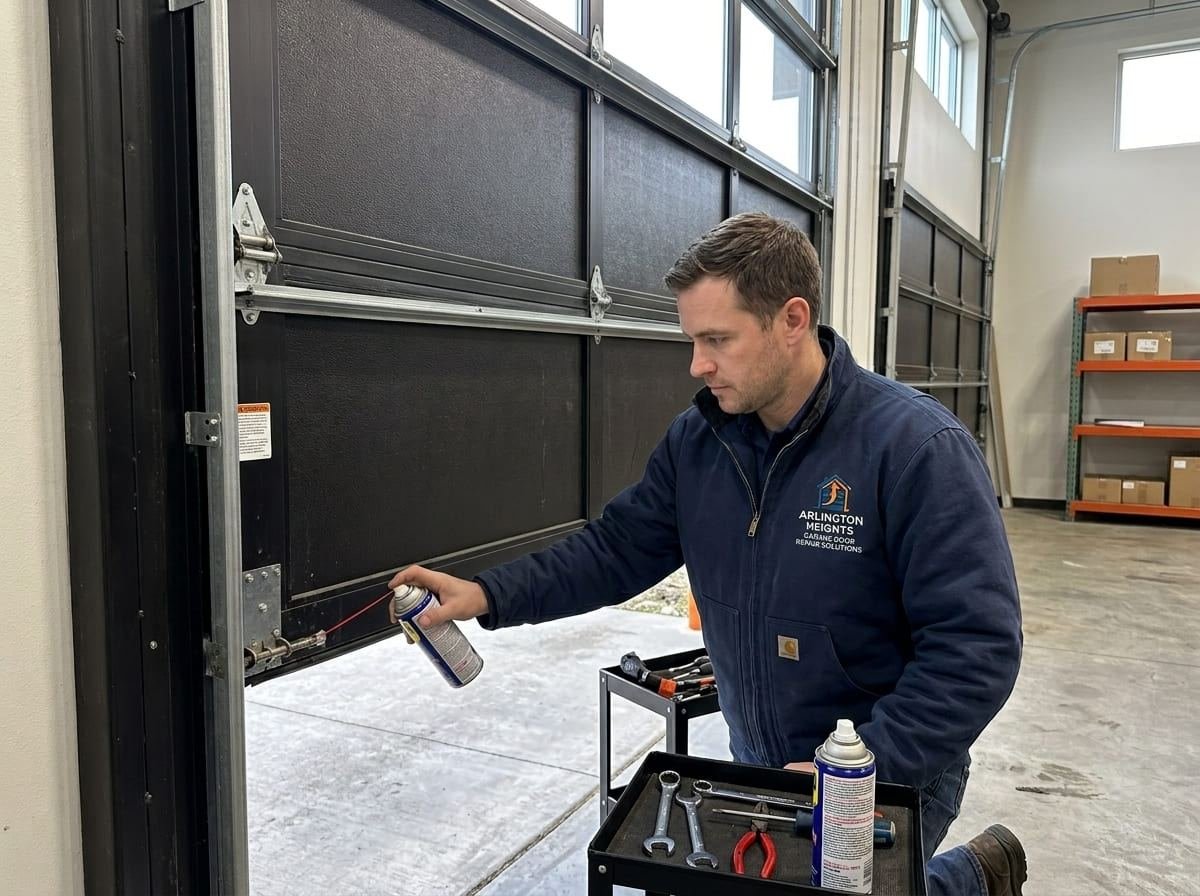
A garage door is a counterbalanced machine with a dozen wear points, and the noisy one is frequently not the broken one. We run the same eight-step sequence on every call. It takes fifteen minutes, and it is why we rarely come back twice.
1. Visual inspection, door closed, power off
Springs first: a torsion spring with a two-inch gap in the coil is broken, full stop. Then cables at the bottom brackets, drums, hinges, end stiles, seal and sections. Rust along the bottom rail of a fifty-year-old door tells us plenty.
2. Manual balance test
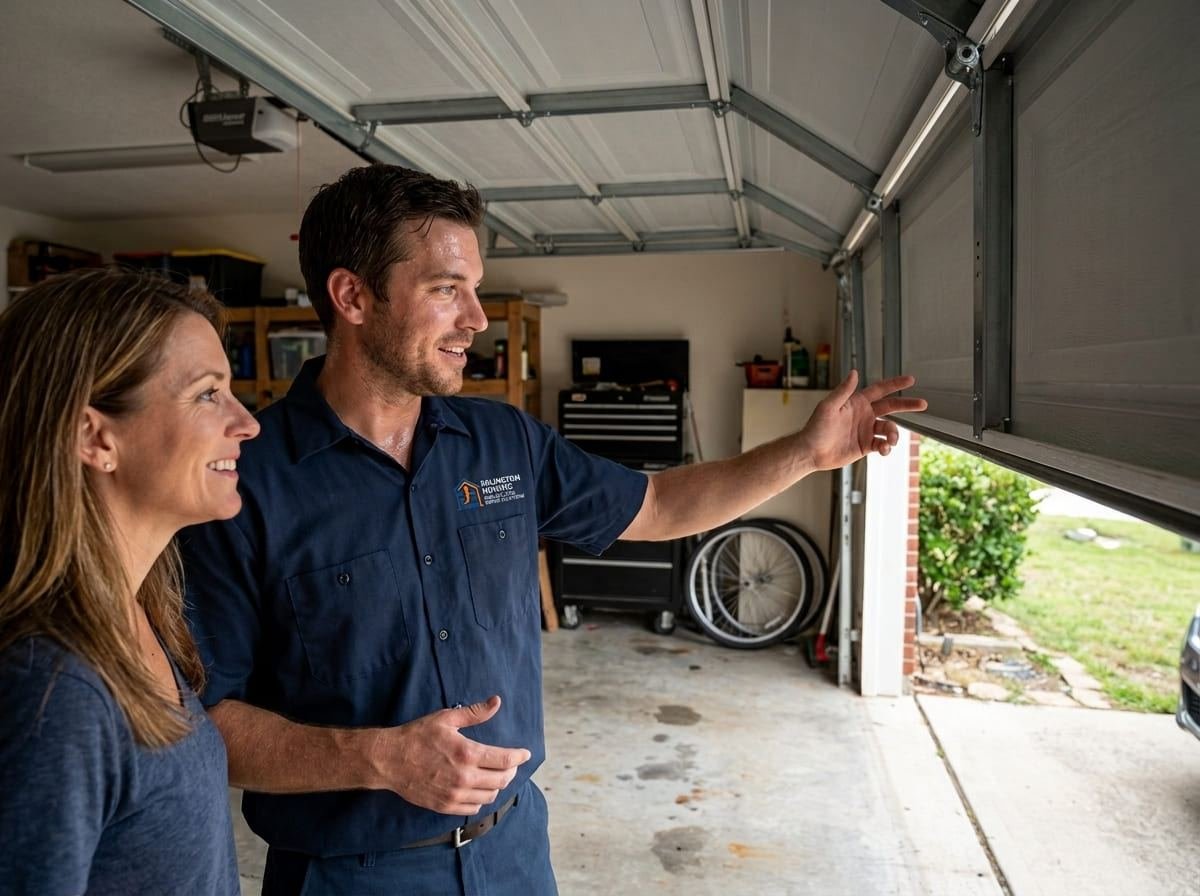
We pull the release, disconnect the trolley and lift by hand. A balanced door moves on two fingers and stays put at waist height. Dropping means under-sprung; fighting upward means over-sprung. This test separates door problems from opener problems faster than anything else.
3. Spring gap, wind count and shaft
On torsion we count the turns wound on against door height and drum size, and check the center bearing plate and cones. On extension springs we check pulleys, S-hooks and whether safety cables run through them. Plenty of 1970s garages here have none.
4. Cables and drums
Lift cables fail in a pattern: fraying at the bottom bracket where salt and meltwater collect, then a broken strand, then failure. We inspect both even when one has gone. A cable out of its drum groove drops one side and pulls the door off track: cable repair.
5. Roller and hinge play
Every roller gets spun by hand and rocked in its stem. Unsealed steel rollers were the builder fitment here, and after twenty Cook County winters most are flat-spotted or seized. Hinges get checked for elongated holes. Those two faults cause most doors that shake the house.
6. Track alignment
Vertical track should be plumb and parallel, horizontal track level and pitched back to the rear hangers. We check roller-to-track clearance along the run and look for the flaring that comes from a door being forced. Bent track is common on a door already off its track once.
7. Opener force settings and travel limits
Force and travel are separate adjustments and both drift. We check both against the door’s balanced weight and inspect gear, trolley, sprocket and rail. More on the opener repair page.
8. Safety reversal test
Last, always. We interrupt the photo eyes, then run the obstruction test the CPSC recommends: a 2x4 flat in the door’s path. A door that will not reverse off the lumber is not finished, whatever we came for.
Symptom, likely cause, and what it needs
The shortlist we work through on the phone.
| What the door is doing | Most likely cause | What it usually needs |
|---|---|---|
| A bang like a gunshot, then it will not lift | Torsion spring fractured; the door is at its full 150–250 lb | Matched-pair spring replacement |
| Closes on a slant, slack cable at the drum | Lift cable snapped or jumped its groove | Both cables replaced, drums reset, balance checked |
| Motor runs, door does not move | Stripped nylon drive gear or sheared trolley | Gear and trolley rebuild, or a new opener |
| Reverses in the last inches before the floor | Down-force or travel limit wrong, or a photo eye out of line | Sensor realignment, limit recalibration |
| Reverses as soon as it starts down, mostly in winter | Bottom seal frozen to the slab, or a binding roller read as an obstruction | Free the seal, replace binding rollers |
| Grinding and rattling through the ceiling | Flat-spotted rollers, loose hinges, dry bearings | Rollers, hinges, bearings, fastener check |
| Hanging at an angle, rollers out of the track | Off track, usually after a cable failure or vehicle contact | Re-track, repair or replace damaged track |
| Gap at the header when closed; lands hard | Spring losing tension, or drums set unevenly | Re-wind or re-spec springs |
| Cracked, dented or buckled bottom section | Vehicle contact, or rust-through along the bottom rail | Panel replacement, or a new door |
| Creeps open, or will not hold at waist height | Counterbalance out of adjustment | Balance adjustment or re-specified springs |
The repairs that make up most of our call volume
A handful of jobs fill most of the year, each signaling something about the door.
- Broken springs
- Our commonest call, concentrated December through February. Signals a component at the end of its fatigue life, and an opener overworked as the counterbalance weakened.
- Cables and drums
- Signals moisture at the bottom bracket, a drum drifting on the shaft, or a door out of level.
- Rollers, hinges, bearings
- Signals age and dry running. Cheapest fix on the door, and the one homeowners notice most.
- Off-track doors
- Signals a failure upstream: a cable, a spring, a collapsed roller. Re-tracking without finding the trigger comes straight back.
- Damaged sections
- Signals impact or corrosion. Recent doors match section for section; a 1970s pan door with a discontinued profile does not, which becomes replacement.
- Openers
- Frequently signals a door fault. Drive gears do not strip on balanced doors; they strip lifting more than they were rated for.
The uncomfortable conversation
Repair or replace: where we draw the line
We repair when
- The failed part is a wear item: spring, cable, roller, hinge, drum
- Sections are straight, dry and sound
- A damaged section still matches a current profile
- The opener has a serviceable fault and meets current safety rules
- It came off track once, for an identifiable reason
We recommend replacement when
- The bottom rail has rusted through, or sections are cracked
- The profile is discontinued and no section can be sourced
- Hinges and end stiles are tearing out of the skin
- It has bowed permanently and struts will not straighten it
- You are three repairs into a single-layer 1970s door
One number worth knowing first
The 2025 Cost vs. Value Report from Zonda and JLC ranked garage door replacement first for return of all 28 projects, in every U.S. region. In East North Central the modeled job averaged $4,357 and returned $12,298 at resale. That is no reason to replace a door with a snapped spring, but when one is genuinely finished, a new door is among the few projects that pays you back.
What arrives with us
What is on the van
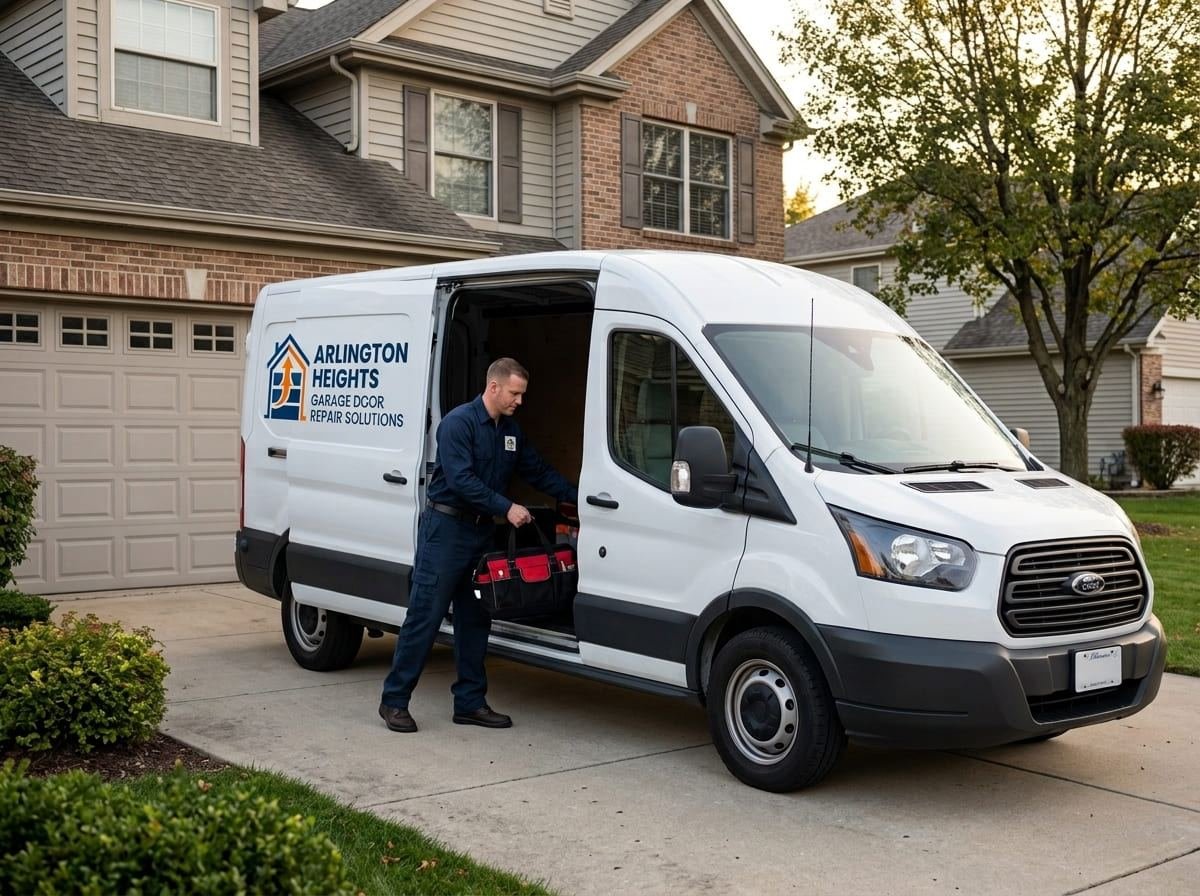
Torsion springs in the common wire sizes for 8 × 7, 9 × 7 and 16 × 7 doors. Extension springs and safety cables. Lift cables, drums, bearing plates, shafts. Rollers. Numbered hinges, end stiles, brackets, struts. Seals. Track. Opener gears, trolleys, sprockets, rails, capacitors, photo eyes, remotes and keypads.
What we do not carry is a section for every profile ever sold in Cook County. Panel work is measured and ordered.
The visit
Between your call and a working door
The phone call
You describe the behavior; we ask the age of the door and what changed. Most calls end with a likely cause.
Diagnosis on site
The eight steps above, in full. Stand and watch if you like; most people do.
Written price first
You see the failed part and the number before anything is touched. The Illinois Home Repair and Remodeling Act gives you rights on work agreed at your door, and we hand those over.
Repair, then the tests
Counterbalance reset, balance re-checked by hand, reversal tested. Old parts leave with us; the warranty is in writing.
Local context
Why doors here fail the way they do
The fault mix here is not random. Census figures put the median year built for Arlington Heights housing at 1974, with roughly 64% built before 1980 and 41% between 1960 and 1979: exactly when the attached two-car garage became standard.
So we work on doors on their second opener and third set of springs, still running original rollers and track. South Arlington Heights, broadly 60005, is older again.
Climate does the rest. O’Hare records a January mean of 25.2 °F and 38.4 inches of snow in the NWS 1991–2020 normals, and the Great Lakes region averages about 42 freeze–thaw cycles a year. Add the deicer arriving on your tires. Our guide to fifty-year-old Arlington Heights garages goes further.
The same stock runs across the village line: Kimball Hill ranches in Rolling Meadows, 1950s streets in Mount Prospect, 1970s subdivisions in Palatine, all of Arlington Heights. We handle residential and commercial doors.
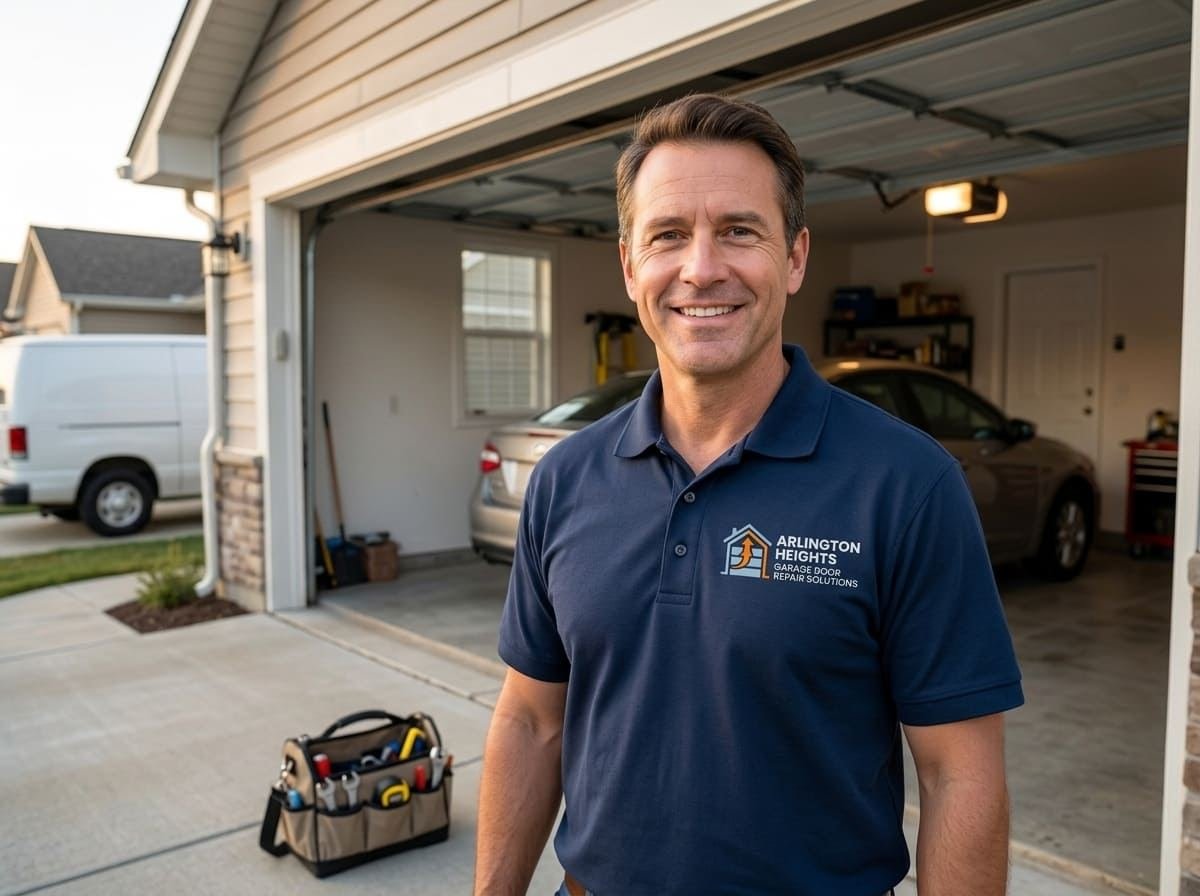
Dale Whitmore
Owner & Lead Technician
Founded the business in 2011 after fifteen years on overhead doors across the northwest suburbs. Registered with the Village of Arlington Heights.
Common questions
Garage door repair in Arlington Heights: your questions
Can you repair my garage door the same day I call?
On most repairs, yes. We are based on N Ridge Ave in 60004, the vans carry the common springs, cables, rollers and opener parts, and nowhere in the village is a long drive. Panel work is the exception. If we cannot reach you today we say so.
How do I know whether the problem is the door or the opener?
With the door closed, pull the emergency release and lift by hand. A healthy door glides up and holds at waist height. Heavy or dropping means the counterbalance is at fault. Fine by hand but the motor cannot manage it? Then it is the opener.
Is it safe to keep using a door that has started making a new noise?
Usually, with one exception. Grinding from worn rollers can wait for a booking. A new bang or snap, or a door hanging unevenly, means spring or cable failure and should be left alone. DASMA’s safety guidance says uneven movement needs a professional.
My door is from the 1970s. Is it worth repairing at all?
Often, yes. Age is not the deciding factor; condition is. A 1976 steel door with straight sections, sound end stiles and a dry bottom rail will take new springs, rollers and cables and run for years. The same door with rust-through and a bow is finished.
Do I need a permit for garage door work in Arlington Heights?
For repairs it does not arise in practice. Replacement is different: the Village publishes no standalone garage door packet, so it falls under Alteration, Remodel, Repair – Residential. We confirm with the Village’s Building & Life Safety department on 847-368-5560 and pull the permit if needed.
Will you try to sell me a new door?
Our technicians are paid no commission on parts, which removes the incentive that makes this trade untrustworthy. We repair wherever repair is the honest answer. If anyone recommends replacement, ask for photographs of the failure. Ask through our contact page.
Tell us what the door is doing
Describe the noise, the movement and the age of the door. Two minutes usually gets us to a likely cause.
Mon–Fri 7am–7pm · Sat 7am–5pm · Emergency call-out outside those hours