
ZIP 60056 · our eastern neighbor
Garage Door Repair in Mount Prospect, IL
Six of every ten homes here were finished before 1970. That statistic explains almost every call we take, from seized extension springs to openings that will not clear a modern car.
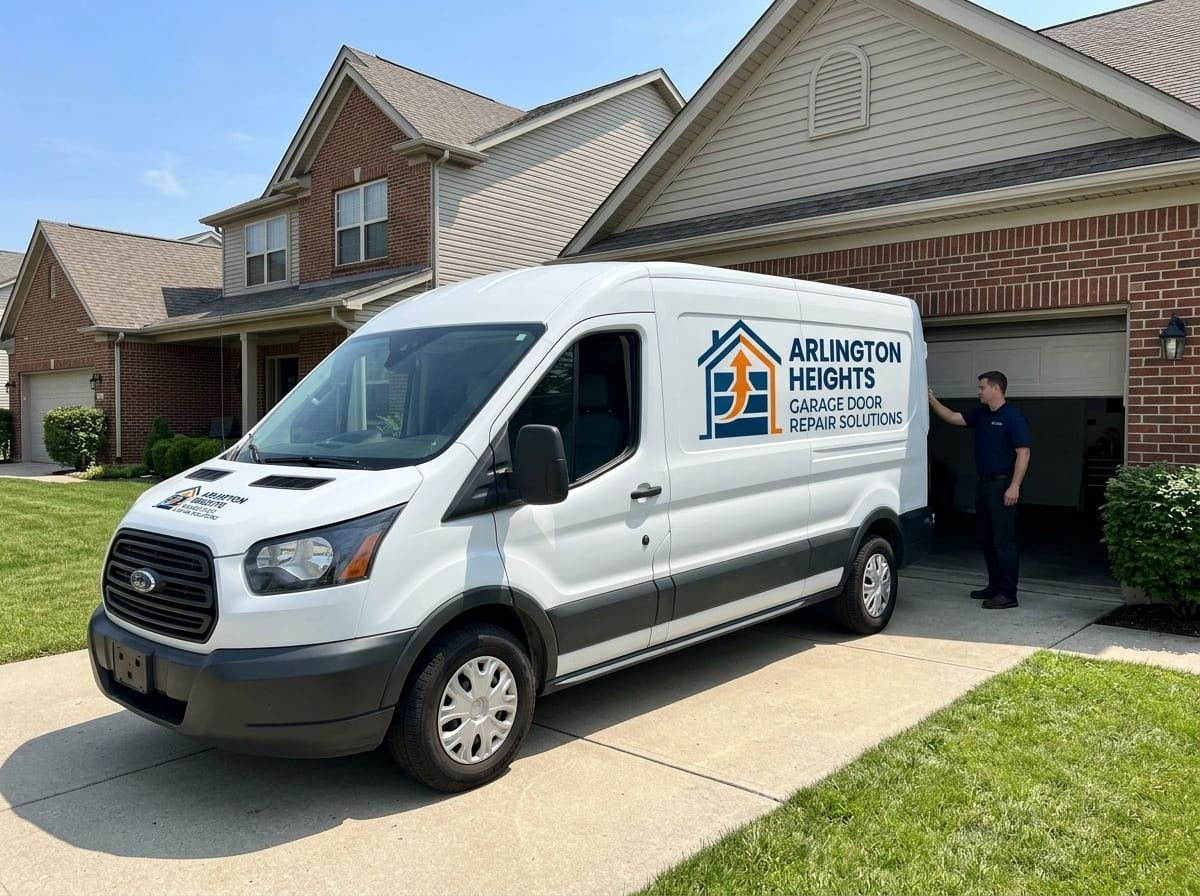
The oldest door market we serve
Three decades built most of Mount Prospect
ZIP 60056 holds about 22,975 housing units.
| Decade | Housing units in 60056 | What that means for the door |
|---|---|---|
| 1940s | ~5,120 | Post-war stock. Detached and single-bay garages, re-roofed and re-sided but never re-doored |
| 1950s | ~5,953 | The largest cohort. Extension-spring systems, frequently without containment cables |
| 1960s | ~5,517 | Attached two-car garages arrive. Original headers, 7-foot openings, early torsion hardware |
Those three decades are roughly 60% of the housing stock, making Mount Prospect the oldest concentrated door market we serve. The village holds 56,852 people across 10.76 square miles, four miles north of O’Hare, median home value near $376,300.
60056 is the only ZIP code for Mount Prospect. Sources listing 60057 through 60059 are wrong, and it is a reliable tell that someone is publishing a scraped table.
Neighborhood by neighborhood
Where the old doors actually are
Country Club
Axel Lonnquist’s garden suburb, laid out around the Mount Prospect Golf Club from about 1925. Spacious lots, Lincoln Middle School inside it, the oldest garages we work on east of Arlington Heights. Many detached, several never wired for an opener, header heights varying house to house.
Brickman Manor
Mid-century brick ranches and split-levels on the north side near the Rob Roy course. Original openings, mostly on a second or third set of springs. Our steadiest source of spring work in the village.
Hatlen Heights
Mid-century, south-central, mature tree-lined streets, no HOA. Heavy canopy keeps driveways damp into spring, and damp rusts a serviceable bottom section.
Elk Ridge Villas
Mid-1960s, south side, no HOA, close to I-90, IL-83, O’Hare and Randhurst. The noisiest, saltiest corner of the village, and the hardware shows it.
Woodview Manor
Mid-century, northeast, along the River Road corridor, no HOA. Same era as Hatlen Heights, with more variation in door sizes, so we measure.
The townhome pockets
A substantial attached-housing layer sits under association control. Color, panel profile and window layout are usually specified, so those jobs start with paperwork and a photograph.
What a 1950s garage door needs that a 2015 one does not
Old doors are not worn versions of new doors. They were built to a different specification, and several things normal in 1955 are no longer acceptable.
Extension springs without safety cables. An extension spring stores its energy stretched along the horizontal track, and when it fails it fails as a projectile unless a cable runs through its center. DASMA calls springs the most important and most dangerous part of a garage door. We fit containment cables as standard on any extension system we touch, whatever you called about.
Openers that predate entrapment protection. Federal rules require openers made after 1 January 1993 to carry either an external entrapment-protection device — the photo eyes near the floor — or a constant-contact close button. Plenty of garages here run older units, or newer ones whose eyes were unbolted because they kept tripping. Neither is acceptable with children in the house.
Openings sized for a 1955 sedan. Country Club and the 1940s streets have single bays under nine feet wide and headers at seven. That constrains what will fit, and it is better discussed with a tape measure than over the phone.
Bottom sections that have spent seventy winters in road salt. Chloride ions break down steel’s protective oxide layer, and salt is hygroscopic, so it keeps pulling moisture from the air long after the driveway looks dry. That is why we cut off so many seized bottom fixtures here. More in our note on road salt and corrosion.
Services for older stock
What we bring on a Mount Prospect call
The van load leans differently here than in Buffalo Grove: more extension-spring hardware, more containment cables, more 7-foot track, more bottom brackets and end stiles, and a wider range of drum sizes.
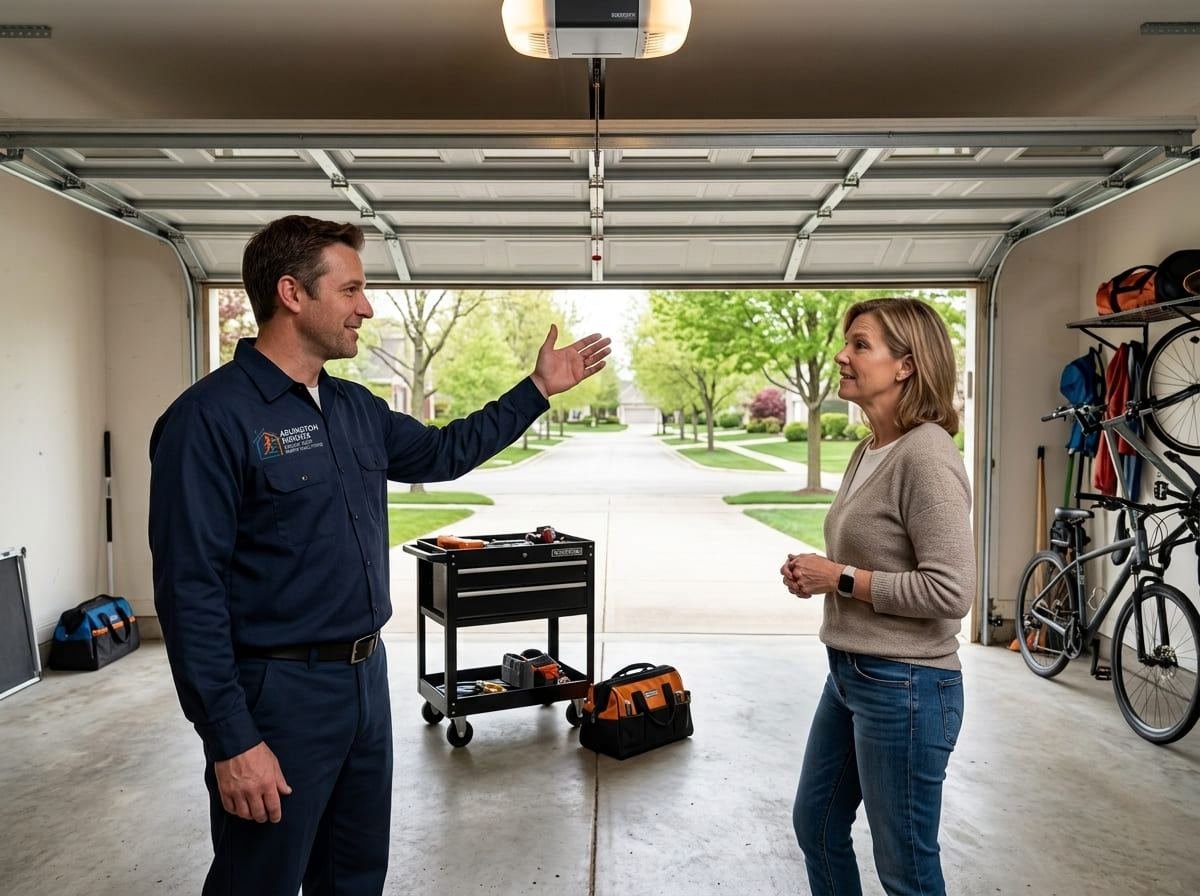
The run east
Ten minutes, and none of it on IL-53
Mount Prospect is the easy direction. From N Ridge Ave we drop onto Central Road, Kensington Road or Euclid Avenue and are in the village in ten to fifteen minutes. Southern addresses come off Golf Road or Elmhurst Road; Rand Road and Northwest Highway handle the diagonal into downtown. Arlington Heights Road and Wolf Road cover the rest.
Because that all runs east, IDOT’s IL-53 reconstruction does not touch these appointments. It affects our westward runs into Palatine and Rolling Meadows, not our eastward ones, which is why same-day slots here are usually easy to find.
Randhurst Village is the landmark everyone navigates by, and the Mount Prospect Golf Club anchors the Country Club streets. The motto, “Where friendliness is a way of life,” is on the signs. Five separate park districts serve parts of the village — Mount Prospect, Arlington Heights, Des Plaines, Prospect Heights and River Trails — which occasionally confuses people about which town they live in. The village history explains it.
Adjacent
Towns we reach on the same eastern run
Mount Prospect borders four of the towns on our service area map and shares three park districts with them. If you are on a boundary street and unsure which village bills you, it makes no difference to us.
Asked in Mount Prospect
Questions from 60056
Our Mount Prospect townhouse association controls the door color. How does that work?
We work to the association’s specification, not around it. Before ordering we photograph the door, record color, panel profile, window layout and hardware style, and send that written specification to you or to the management company for sign-off. Nothing is ordered until it comes back approved. An unsafe door can be secured meanwhile.
Our Country Club garage is detached and dates to the 1920s. Can it take a modern opener?
Usually, but the structure decides. We check the header, the ceiling framing and whether a suitable power circuit exists, because a detached garage from that era often has neither an adequate mounting point nor a dedicated outlet. Where headroom is tight, a wall-mounted jackshaft beats a ceiling rail. We say which before you commit.
The garage opening is only seven feet high. Will a new door still fit?
Yes, 7-foot doors are still standard and readily available. What catches people out is headroom above the opening: a conventional torsion assembly wants around 12 inches of clear space above the header. Where there is less, we use low-headroom double track or move the operator to a jackshaft. We measure before quoting.
Do you disconnect the photo eyes if they keep tripping?
No. Photo eyes are the external entrapment protection required on openers made after 1 January 1993, and the CPSC has documented children killed under non-reversing doors. Nuisance tripping means misalignment, a loose bracket, a damaged wire or eyes mounted too high — LiftMaster specifies no higher than six inches. We fix the cause. See our 30-day safety check.
How quickly can you get to Mount Prospect from Arlington Heights?
One of the shortest runs we make: ten to fifteen minutes on Central, Kensington or Euclid, unaffected by the IL-53 works. Most repair calls placed in business hours get a same-day slot, and emergency call-out is available outside posted hours. If the day is genuinely full we say so rather than booking you and hoping.
Is it worth insulating a garage door in a 1950s Mount Prospect house?
Only if the garage is conditioned or the room above it is cold. An unconditioned attached garage has no mandatory U-factor under the energy code, so it is a comfort decision, not a compliance one. If you do buy insulated, ask for the ANSI/DASMA 105 U-factor of the complete door rather than a section-only R-value — DASMA says section R-value should not be used for assemblies.
More on the crew, the warranty and how we price: our about page.
Old doors are our normal, not our exception
Extension springs, seventy-year-old track, detached garages with no power. Tell us what you have and we bring hardware that suits it rather than a new build.
Mon–Fri 7am–7pm · Sat 7am–5pm · Emergency call-out outside those hours