
Sections & panels · Arlington Heights, IL
Garage Door Panel Replacement in Arlington Heights, IL
A dented section is not automatically a new door, and a new door is not automatically a rip-off. Garage door panel replacement in Arlington Heights works beautifully on some doors and wastes money on others.

When a section can be swapped, and when it cannot
Sectional doors are built to come apart, so any section can in principle be replaced. Three things decide whether that is a good idea.
- Is the profile still made? Manufacturers change profiles, embossing and rail proportions between generations. A 2016 door in a current range is usually straightforward; a 1994 door with a discontinued long-panel profile means a near-match that reads wrong from the street, or nothing at all.
- Will the finish match? Factory paint fades. Twenty years of southern exposure leaves a chalked, warm white a new section will not resemble, and the two then sit side by side permanently. Almond and sandstone are the worst.
- Has the rest of the door gone? If surrounding sections are cracked at the hinges, the end stiles are soft, or the top section has pulled at the opener arm, a fresh panel is a splint on a broken frame.
The arithmetic nobody volunteers
One section on a current-production door is usually good value. Two is marginal. Three replacement sections often approaches the cost of a new door — replacement money for something that keeps its original track, springs, rollers and age.
We tell you when that line is crossed. Our technicians are not paid commission on parts, so nobody in the van has a reason to steer you either way. Near the threshold, price sectional repair against a full garage door replacement.
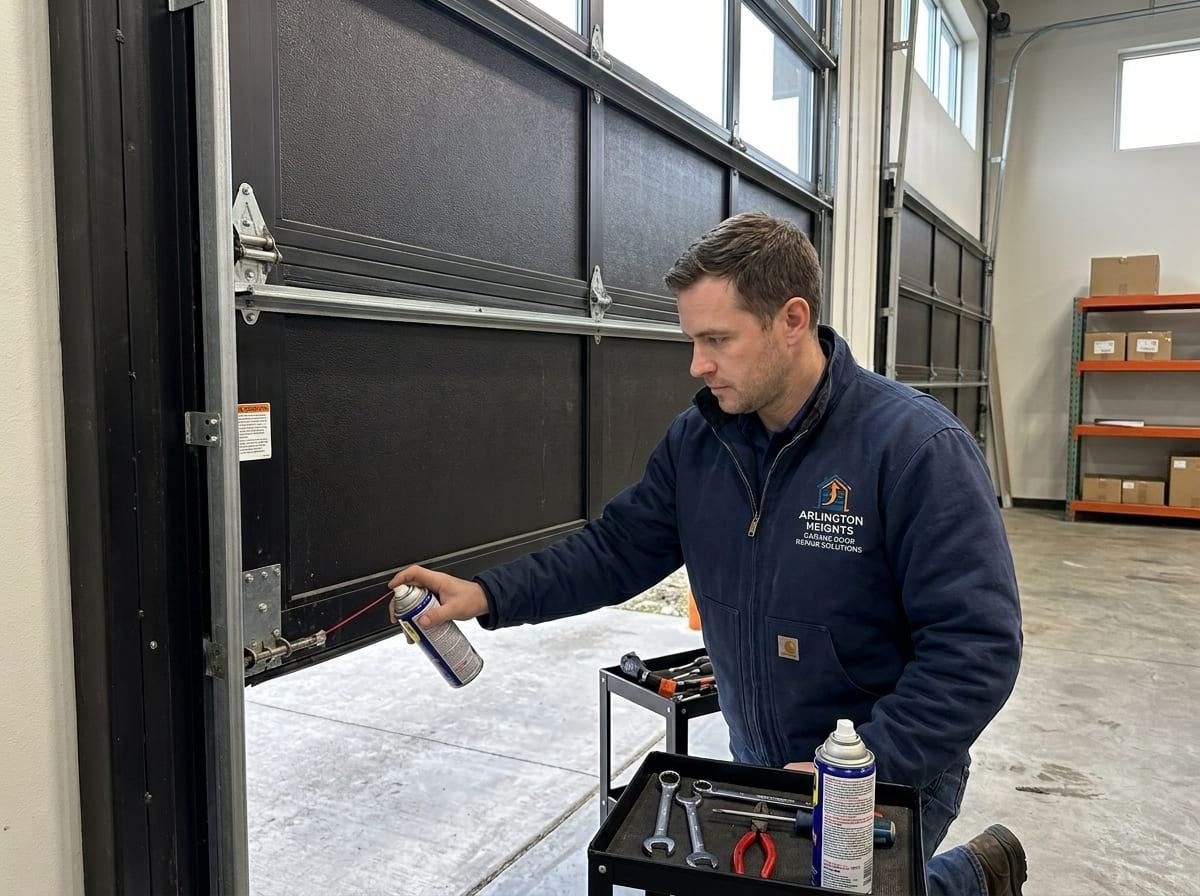
The bottom section goes first in this climate
On almost any twenty-year-old door here the damage sits in the lowest 18 inches. Three reasons.
- Road salt. Salt is hygroscopic: it pulls moisture from the air, raises the conductivity of the film on the steel, and its chloride ions break down the protective oxide layer. The International Molybdenum Association’s review of deicing salt corrosion notes corrosion peaks at particular humidity and temperature combinations, when the chloride solution is most concentrated. Your car drips it six inches from the bottom section.
- Standing meltwater. Snow packed into wheel arches melts overnight against the closed door, and the bottom rail sits in it.
- The seal freezing to the slab. A wet bottom seal freezes to the concrete overnight. Next morning the opener applies full force the other way and tears the astragal out of its retainer, or peels the bottom of the section. The Great Lakes region averages roughly 42 freeze–thaw cycles a year.
Caught early this is a seal and retainer job; caught late, a section. The chemistry is in what road salt does to a garage door.
Vehicle impact: check well past the dent
Backing into the door is the other common reason we replace sections, and the visible damage understates it:
| What we inspect | What impact does to it |
|---|---|
| Hinges at the struck section | Bent leaves, elongated knuckle holes. One that looks straight can still hold a roller out of line. |
| End stiles | Tweaked or dished, pulling the roller stem out of parallel with the track. |
| Struts | A bowed strut means the energy travelled along the door, not just into it. |
| Rollers and stems | Pushed out of alignment, flat-spotted, or bent inside the hinge out of sight. |
| Track and brackets | Splayed vertical track, loosened flag bracket, kinked radius. Track repair, corrected first. |
A hard impact also unseats a cable from its drum, which sends a door off-track a week later. If yours has already jumped, stop using the opener: that is off-track door repair, and it worsens with every cycle.
Not damage
A bowed insulated panel is often thermal, not broken
Every winter we are called to doors with a visible curve across a section, and homeowners reasonably assume something has failed. Often nothing has.
DASMA Technical Data Sheet #185 addresses it directly. All insulated bonded-core sections bow to some degree under a temperature difference between the inside and outside faces — the condition of a heated attached garage on a −10 °F January morning. The section bows toward the warmer skin. On a 20-foot door, DASMA says unreinforced thermal bow “could exceed several inches”, and is explicit that this is an inherent characteristic, not a product defect. It is worse on wide doors, dark colors and thermally-broken construction. The mitigation is mechanical: horizontal struts across the back of the sections, which is why we specify them on wide insulated doors as standard.
How to tell the difference
Thermal bow comes and goes with the temperature differential. Damage does not. If the curve is identical on a mild April afternoon, we are looking at a deformed section. Full explanation: thermal bowing on insulated garage doors.
Finish
Matching paint and finish
Where the door is a current model in a standard color the factory match is generally good. Otherwise there are two honest routes: paint the new section to match the weathered ones, or repaint the whole door.
Steel skins take exterior acrylic latex well once cleaned and primed on bare metal. What does not work is leaving a bright new section among twenty-year-old ones and hoping it weathers in. It will, over about eight years.
We replace the weatherseal, astragal and retainer on any bottom-section job, because the hardened old rubber is usually what caused the problem. Upkeep guidance: DASMA’s maintenance guide.
Safety
Why a removed section is not a DIY job
Taking a section out changes the weight the springs are balancing, and the springs do not know that. A counterbalance wound for a complete door is over-sprung once a section is out, and the rest wants to run up hard.
Doing it safely means clamping the door below the roller path, releasing spring tension where needed, supporting the sections above the gap, and keeping fingers out from between sections under load. DASMA calls springs the most dangerous part of a door.
Then the door is re-balanced and the opener force settings reset, because a replacement rarely weighs what the old section did.
Common questions
Panel replacement: what homeowners ask
Can you replace just one panel of my garage door?
Usually, if the door is a current or recent model and the profile is still made. We check with the manufacturer before quoting. Where the profile is discontinued, or the finish has faded past anything a new section will match, we say so rather than fit something that looks wrong.
How do I know whether to replace a panel or the whole door?
One damaged section on a sound, current-production door is straightforward. Two is marginal. Three often approaches the cost of a new door, and by then you are spending replacement money on old track, springs and rollers. See our replacement page.
My insulated door has developed a curve. Is it damaged?
Possibly not. DASMA TDS #185 confirms all insulated bonded-core panels bow under an inside-to-outside temperature difference, and that this is inherent rather than a defect — on a 20-foot door, unreinforced bow could exceed several inches. If the curve is identical in April and January, it is deformation.
Someone reversed into my door. What should I do first?
Stop using the opener. An impact can unseat a cable, tweak an end stile or splay the track, and cycling turns a one-section job into a multi-part one. Leave the door where it is and call us.
Do you do panel work on commercial doors?
Yes. Tom Delaney runs our commercial side, and impact damage to loading-bay sectional doors is routine work here. Duty cycle and downtime drive the decision differently. See the commercial garage doors page, or get in touch.

Dale Whitmore
Owner & Lead Technician
Dale founded the business in 2011 after fifteen years fitting overhead doors around the northwest suburbs. More about us.
Show us the damage before you decide
Model number, a photo, and where the dent or the rust is. Normally enough to say whether the section is available and whether it is the right thing to buy.
Mon–Fri 7am–7pm · Sat 7am–5pm · Emergency call-out outside those hours