
Repair or replace · Arlington Heights
Garage Door Replacement in Arlington Heights, Illinois
Most doors get replaced too late, a few too early. This page is about the decision rather than the mechanics: where the honest thresholds sit, what the resale numbers actually say, and how to specify a garage door replacement in Arlington Heights so it outlives the one before it.
- We quote the repair as well as the replacement, then let you choose
- Technicians are not paid commission on parts or on new doors
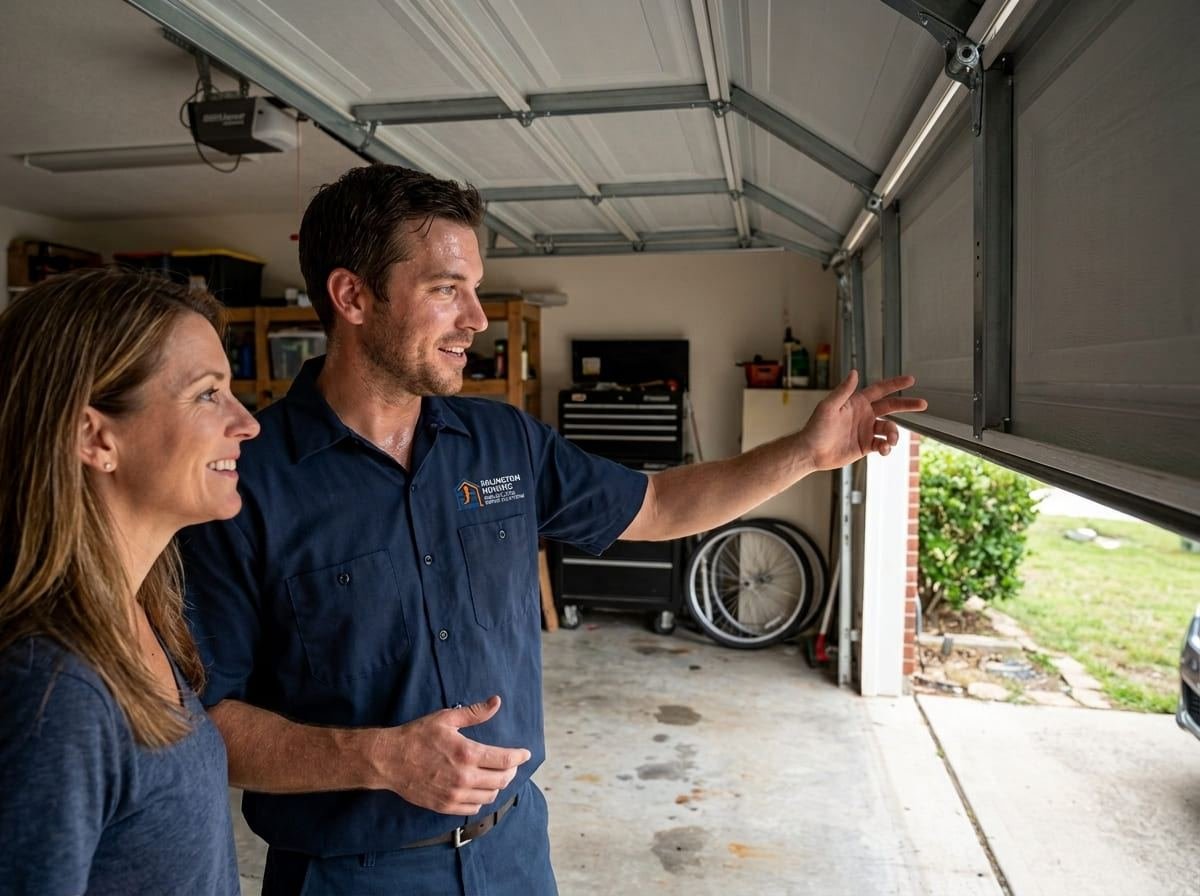
Six thresholds that move a door from repair to replace
There is no single trigger, and any company that gives you one is selling. What exists is a set of conditions where continuing to repair stops being good value. When two or more are true at once, we say so.
1. Age past roughly twenty to twenty-five years
Not because a door expires on a date, but because that is when parts availability, section corrosion and hardware fatigue tend to arrive together. Manufacturers put the typical replacement interval at around ten years, which we think is pessimistic for a well-made insulated door. A builder-grade door from 1998 that has never had a strut or bearing plate replaced is a different matter.
2. Rust through the bottom section
The bottom section takes the salt, the meltwater and the standing slush. Surface rust is cosmetic and treatable. Rust that has perforated the steel, delaminated the skin from the core or eaten the astragal retainer is structural. You can bolt a repair plate on; you cannot restore the section’s stiffness.
3. Multiple cracked or delaminated panels
One damaged section is a panel replacement conversation. Three are a door conversation. Cracks radiating from hinge locations mean the section has carried load it was never stiff enough for, and replacing one moves the failure to the next along.
4. A door that has come off-track repeatedly
Once is an incident, usually a broken cable or an impact. Twice is a symptom. Three times means the track, the framing behind it, or the door’s own geometry has gone out of true, and each derailment bends stiles and rollers further. We fix off-track doors constantly, and we also say when one has stopped being worth putting back.
5. Wood doors past their finish life
Chicago summers average a July mean of 75.4 °F with high dewpoints, on 37.86 inches of annual precipitation. A wood door left to check, lift and gray has taken water into the timber, and that water hangs off springs wound for a dry door. Refinishing a sound wood door is worthwhile; refinishing one with soft rails is money spent twice.
6. Parts that are no longer made
Discontinued section profiles, obsolete hinge patterns, proprietary track from a manufacturer that left the market. When a repair means fabricating or scavenging, it stops being reliable. Common on doors from the mid-1980s and earlier.

The resale numbers, cited properly
Garage door replacement has an unusually good reputation for return on investment, and unlike most claims in this trade it holds up at the source.
The 2025 Cost vs. Value Report, published by Zonda on JLC Online, put national garage door replacement at an average job cost of $4,672 against a resale value of $12,507: 268% of cost recouped, ranking it first of all 28 projects analyzed and first in every one of the nine U.S. regions.
Our region beats that. In East North Central — Illinois, Indiana, Michigan, Ohio and Wisconsin — the same project came in at $4,357 average cost, $12,298 resale value and 282.2% recouped.
Read the spec before you compare the numbers
Cost vs. Value models one specific upscale job: a 16 × 7 four-section door, heavy-duty galvanized tracks, high-tensile galvanized hinges, thermally insulated. That is not the same product as the $1,230 national average install HomeAdvisor reports. Neither figure is our price — ours comes from measuring your opening.
The full write-up, including the three-year ROI trend: garage door replacement ROI and the Cost vs. Value data.
Curb appeal
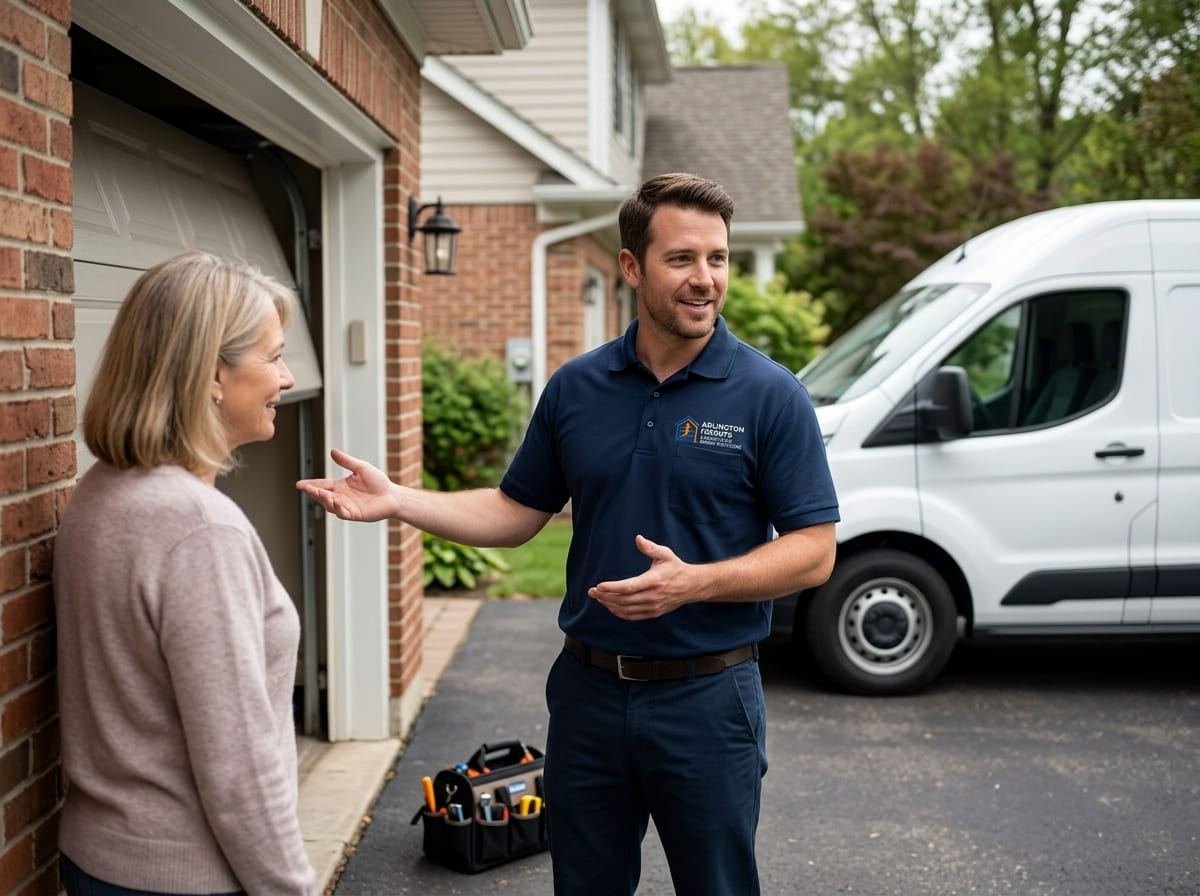
It is the largest thing on the front of your house
Garage doors have traditionally occupied around 30% of a home’s front elevation, and on modern homes with front-facing three-car bays that can exceed 50%. No other component on the facade does that much visual work, which is much of why the resale numbers behave as they do.
So color, panel profile and hardware matter more than homeowners expect. A raised-panel steel door in almond on a 1970s split-level reads as original equipment. The same opening in a flush or shaker profile, darker, with matched trim, changes the whole elevation. Full-view aluminum is spectacular on the right house and jarring on the wrong one.
One caution on very dark colors: a dark, thermally-broken insulated door in direct sun with a warm garage behind it is the combination that maximizes thermal bowing. Manageable with struts, but worth knowing before you pick the swatch.
What a fifty-year-old Arlington Heights garage needs goes into the house styles here in more detail.
Specification
Five things to put in writing before you sign
A quote reading “insulated steel door, fitted” is not a specification. These entries decide how the door behaves in year eight.
- U-factor
- Tested to ANSI/DASMA 105 on a complete installed door, not a section R-value. Lower is better; 0.20 is twice as efficient as 0.40. Ask for the number.
- Wind load
- Wide, thin doors flex. Reinforcement specified for wind load resists the pumping that loosens hinges and pops rollers out of track over a decade of Chicago gusts.
- Cycle-rated springs
- Manufacturer specifications tested to ANSI/DASMA 109, not an industry minimum. A cycle is one full open-and-close. If the garage is the family’s main way in and out, buy more cycles than the base spring offers.
- Strut reinforcement
- Horizontal struts across the back of the sections: required on wide doors and at the opener arm, and genuinely useful on any insulated door here for controlling thermal bow.
- Hardware grade and finish
- Galvanized track and hinges, nylon-tired rollers on sealed bearings, bearing plates you can actually grease. Road salt finds untreated steel fast.
Lead times, and what happens to the old door
Stock sizes in common colors move quickly. Custom widths, non-standard heights, specialty finishes, glazing packages and carriage-house overlays are built to order, and that is where weeks appear. We give the lead time at quote stage and order nothing until you have signed off the spec, because a door built in the wrong color is nobody’s warranty claim.
If the existing door is unsafe or insecure while you wait, say so. We can usually stabilize it so you are not leaving the house open for a fortnight — an emergency call-out if it happens outside posted hours.
On the day, the old door leaves with us: sections, track, springs, cables and hardware, disposed of or recycled. The mechanics of what goes back in are on our garage door installation page.
Who is quoting you
A quote you can argue with
Dale Whitmore started this business in Arlington Heights in 2011, after fifteen years fitting overhead doors around the northwest suburbs. Our technicians earn no commission on parts or doors, which removes the incentive that makes replacement quotes untrustworthy.
We are licensed, insured and registered as a contractor with the Village of Arlington Heights. Under the Illinois Home Repair and Remodeling Act you get the consumer rights pamphlet before signing, a written scope, and three business days to cancel.

Common questions
Replacing a garage door: what people ask us
Is it worth replacing a garage door before selling the house?
The data says yes more strongly than for almost any other project. The 2025 Cost vs. Value Report from Zonda and JLC put garage door replacement first for ROI out of 28 projects nationally, and East North Central — Illinois included — recouped 282.2% of an average $4,357 job cost. The report models a specific upscale spec, so match it against what you are quoted.
My door is 30 years old but still works. Should I replace it?
Not automatically. Age alone is not a fault. We look at whether the bottom section is sound, whether there are cracks at the hinge locations, whether parts are still available, and whether the door balances with the opener disconnected. A sound 30-year-old door with a fresh counterbalance can keep going. One failing three of those is spending your money in installments.
Can I replace just the door and keep the opener?
Often, yes, provided the opener is sound and its force settings can be reset to the new door’s weight, usually higher on an insulated replacement. What matters more than age is whether it meets current entrapment protection requirements and whether photo eyes and reversal work. A pre-1993 unit with no external entrapment sensing should be replaced. See opener repair.
How long does a garage door replacement take?
Fitting is usually a half-day for a standard single or double opening, including taking the old door away. The longer part is manufacturing: stock sizes and colors move quickly, custom widths, glazing packages and carriage-house overlays are built to order and can add weeks.
Do you replace commercial garage doors as well?
Yes. Tom Delaney runs our commercial side: sectional overhead doors, rolling steel doors and dock equipment for businesses across the northwest suburbs. Specification there is driven by cycle count and duty rather than curb appeal. Details on the commercial garage doors page.
Will you tell me if I do not need a new door?
Regularly. A snapped spring on an otherwise sound door is a spring job. A single dent on a current-production profile is a section job. Our technicians are not paid commission on parts or doors, so nobody in the van has a reason to talk you upward. Where replacement genuinely is better value, we show you the evidence on the door.
Find out which side of the line your door is on
Age, symptoms, where the damage is. Two minutes on the phone usually tells us whether this is a repair, a section or a whole door. Quotes are written and fixed against a named spec.
Mon–Fri 7am–7pm · Sat 7am–5pm · Emergency call-out outside those hours