
Chain, belt, screw & wall-mount · Arlington Heights
Garage Door Opener Repair in Arlington Heights, IL
The door might be perfectly healthy. The thing bolted to your ceiling might not be. Working out which is which takes about a minute, costs nothing, and stops you buying a motor when what failed was a spring.
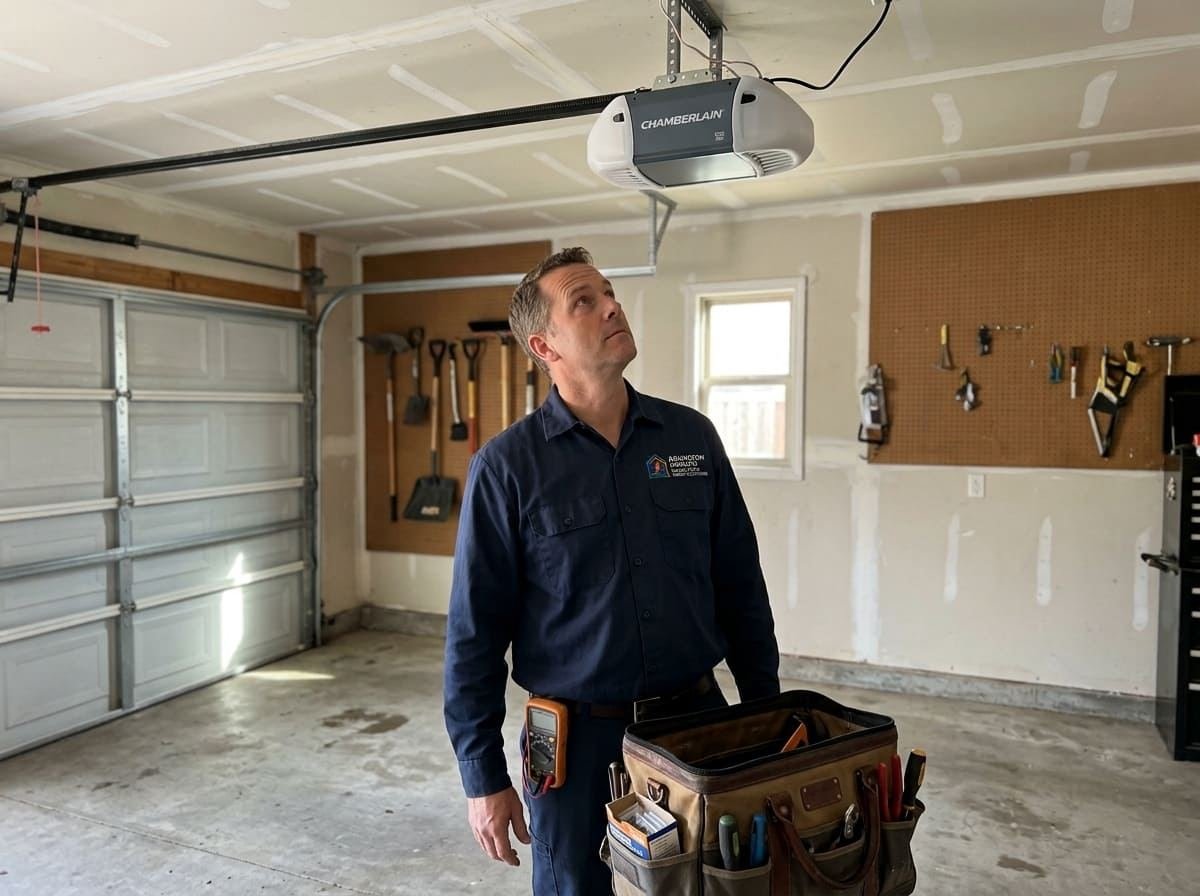
Four drives, four ways to fail
What is above your car determines what goes wrong with it, and how much is worth saving.
Chain drive
A steel chain pulls the trolley along a rail. Loud, cheap and durable, and the standard fitment in the 1970s and 1980s garages we work in daily. Failures cluster around the sprocket, the tensioner and the nylon drive gear inside the head. Rattle and slap usually mean chain tension, not a dying motor.
Belt drive
A reinforced rubber belt in place of the chain. Much quieter, which matters when there is a bedroom over the garage. Belts stretch, fray at the trolley attachment and eventually slip; the motor and gearbox behind them fail exactly as a chain unit’s do.
Screw drive
A threaded steel rod turns and drives the trolley along it. Fewer moving parts, but rod lubrication matters enormously and stiffens badly in an unheated Illinois garage in January. Most screw-drive faults are a dry or contaminated rod and a worn drive nut.
Wall-mount and jackshaft
Mounted beside the door on the torsion shaft, so the ceiling stays clear. Common on new builds and high-lift conversions. They fail differently: cable tension monitor, integrated deadbolt and shaft coupling are the parts we replace, and they depend on a correctly balanced door far more than a ceiling unit does.
The faults we find most often
- Stripped nylon drive gear. The classic. The motor runs, you hear a whirring or grinding from the head, and nothing moves. Nylon shavings in the housing confirm it.
- Sheared trolley or carriage. The chain or belt moves but the door does not, or the trolley travels and the arm stays put.
- Worn sprocket. The chain jumps teeth, the door judders, travel drifts.
- Failed capacitor. The unit hums but will not start, or starts only with a push. Very common on older AC units.
- Logic board failure. Often after a summer power surge. Lights flash in patterns, controls behave inconsistently, or the unit is simply dead with power at the outlet.
- Misaligned or dirty photo eyes. The door closes an inch and reverses, or refuses to move down at all. A knocked bracket, a cobweb or a low sun angle will do it.
- Force and travel limits out of adjustment. The door slams, stops short of the floor, or reverses in the last few inches.
- Worn remotes and keypads. Dead batteries, cracked membranes, or a receiver that lost its programming after a power cut.
Opener fault or door fault? One test settles it
Before anyone quotes you for a new opener, do this. Close the door, unplug the unit, pull the red release cord to disconnect the trolley, and lift the door by hand.
Read the result honestly
A healthy door rises on two fingers and stays put at waist height. Heavy, dropping, or refusing to hold means the problem is the door, not the opener. The counterbalance has gone off and the motor has been compensating for months. A new opener on that door dies exactly as the old one did. Start with the springs.
If the door glides by hand and the motor still cannot manage it, the fault genuinely is the opener: gears, trolleys, capacitors, boards.
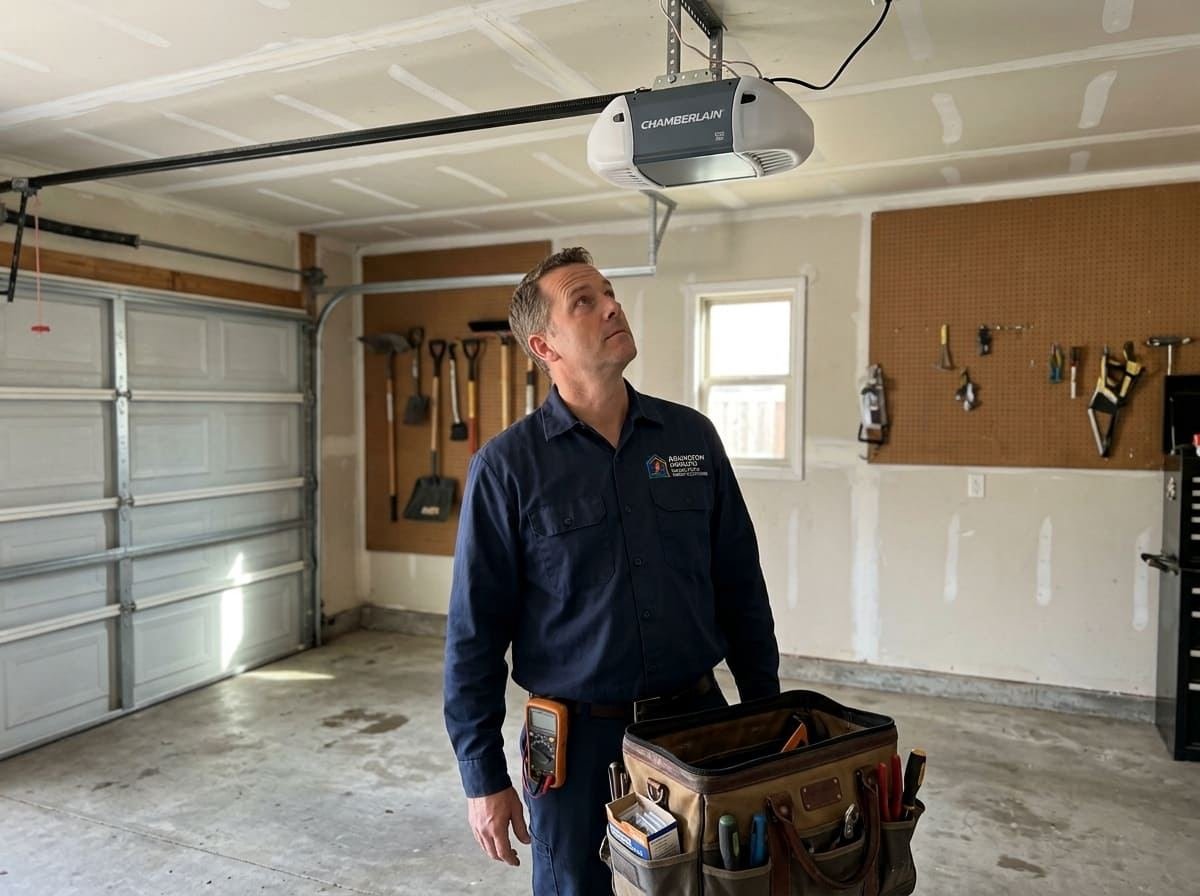
What the opener is doing, and what it usually means
| Behavior | Usual cause | Typical fix |
|---|---|---|
| Motor runs, door stays still | Stripped drive gear or sheared trolley | Gear kit and trolley, or a new unit if the board is also failing |
| Hums, will not start | Failed capacitor or a seized gearbox | Capacitor replacement; gearbox usually means replacement |
| Closes a few inches, then reverses | Photo eyes misaligned, dirty or wired loose | Realign to within 6 inches of the floor, clean, re-terminate |
| Reverses just before touching down | Down force or down travel limit set wrong | Recalibrate limits and force after a balance check |
| Runs, stops, reverses partway up | Binding rollers or track, read as an obstruction | Roller and track work, then re-set force |
| Chain slaps and the door judders | Chain tension or a worn sprocket | Re-tension, replace sprocket; see noise diagnosis |
| Wall button works, remotes do not | Lost programming, dead batteries, failed receiver | Re-learn remotes; replace the logic board if the receiver is gone |
| Lights flash, nothing responds | Diagnostic code, commonly a sensor or board fault | Read the code, test the sensor circuit, then decide |
| Dead with power at the outlet | Board failure, often after a surge | Board replacement, or a new opener on an older unit |
The safety rules your opener has to satisfy
This is not optional equipment, and it is why we test rather than assume. Federal rule 16 CFR 1211, incorporating UL 325, requires four things to work:
Inherent reversal
The operator must reverse the door within two seconds of striking an obstruction, using its own force sensing.
External entrapment sensing
A separate device, in practice the photo eyes, monitoring the area under the door. LiftMaster specifies mounting them no higher than 6 inches from the floor, which is child height, not shin height.
A 30-second backup clock
If a close cycle takes longer than 30 seconds, the operator must reopen the door.
Manual detachment
The red release handle, so the door can be separated from the operator in a power cut.
The CPSC recommends testing every 30 days with a 2x4 flat in the door’s path. Four minutes; our 30-day safety check walks through it.
When repairing an opener stops making sense
There is a hard line and several soft ones. The hard line is age.
Openers manufactured after 1 January 1993 had to include external entrapment protection, either photo eyes or a constant-contact wall control. Anything built before that date does not have it and cannot be brought up to standard by adding parts, because the logic board was never designed to monitor a sensor circuit. If your unit predates 1993, we will recommend replacement and we will not fit parts to keep it running.
The soft lines: a failed board on a unit past fifteen years, a stripped gear on a motor with worn bearings, or a bill approaching the cost of a current belt drive with battery backup and rolling-code security. A gear kit and trolley on a sound ten-year-old opener is money well spent, and we say so.
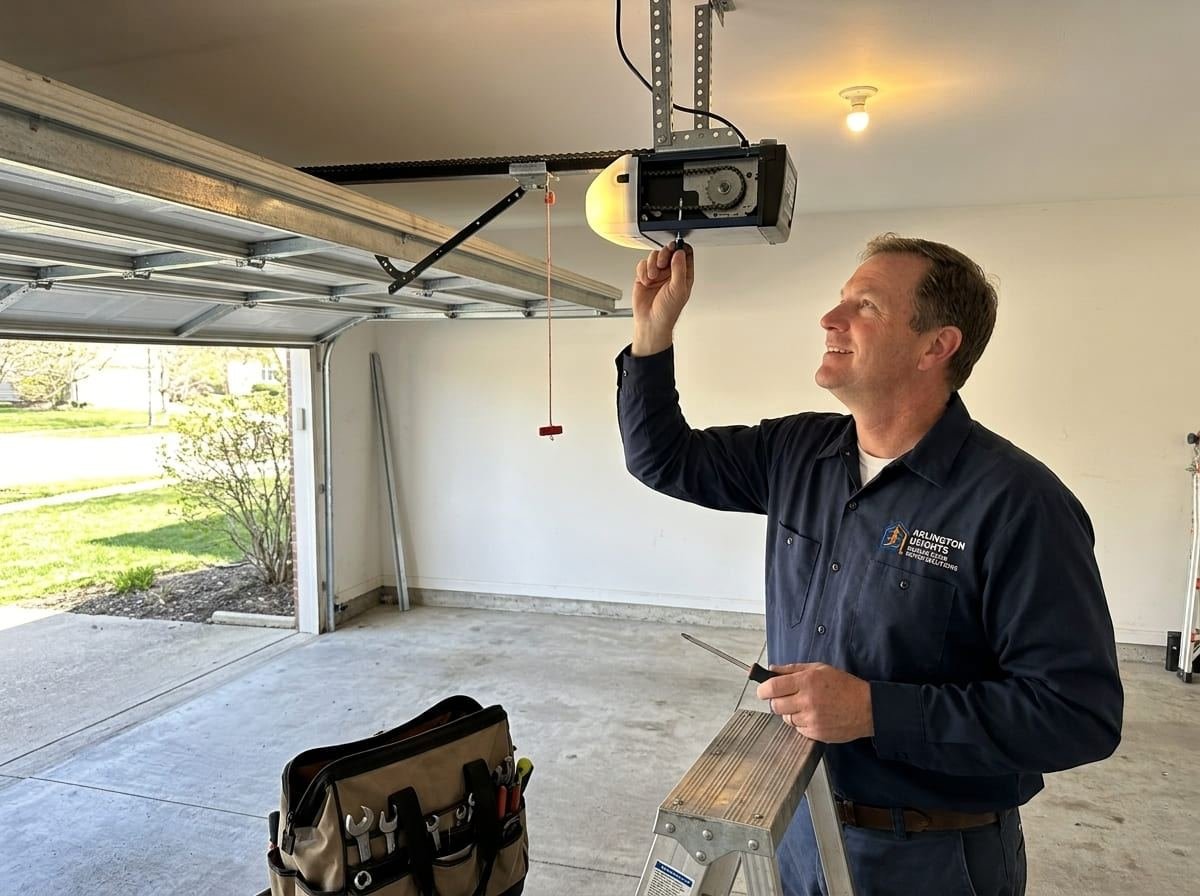
Local pattern
Why openers here work harder than they should
An opener here is usually lifting a door older than it is. With the median local home built in 1974, we routinely find a fifteen-year-old motor above a fifty-year-old door on original steel rollers and tired springs. All of that is friction, and friction is load the gearbox absorbs.
Winter compounds it. Grease stiffens, weatherseal hardens, and a bottom seal frozen to the slab reads as an obstruction, so a healthy opener reverses and gets blamed for a fault it is preventing. Before we sell anybody a motor, we check the door.
Questions
Opener questions from Arlington Heights garages
My opener hums but the door does not move. What is that?
Two usual suspects. On an older AC unit, a failed starting capacitor: it buzzes, will not turn, sometimes starts if nudged. The other is a stripped nylon drive gear, where the motor spins freely and you hear whirring with no movement. Shavings in the housing settle it. Both are repairable on most units.
The door closes a foot then goes straight back up. Why?
Nine times in ten it is the photo eyes. Check both indicator lights are steady, that the brackets have not been knocked, and that nothing is in the beam. They must be mounted no higher than 6 inches from the floor. If the eyes are clean and aligned, the next candidates are down-force set too low or a roller binding in the track.
Is it cheaper to repair my opener or replace it?
Depends on age and what failed. A gear kit or trolley on a sound ten-year-old opener is worth doing. A logic board on a fifteen-year-old unit with worn bearings is not. Anything made before 1993 gets replaced regardless, because it lacks external entrapment protection. We give you both numbers.
Can you fix a screw-drive opener, or do they all need replacing?
We repair them. Screw drives get a bad reputation in Illinois because the rod lubricant thickens in the cold and the door starts laboring, which reads as a dying motor. Cleaning the rod and re-greasing with the correct lithium product transforms most of them. Drive nuts and couplers are replaceable too.
My remote stopped working but the wall button is fine. What now?
Start with the battery, then re-learn the remote to the unit. If several remotes and the keypad all fail together while the wall control still works, the receiver in the logic board is the likely culprit. On many units that means a board, and on an older opener that is the point where replacement becomes the sensible answer.
How often should the safety reversal be tested?
Every 30 days, per the CPSC. Lay a 2x4 flat on the floor in the door’s path and close the door: it must reverse on contact. Also wave an object through the photo-eye beam mid-close and confirm the door reverses. If either test fails, stop using the opener and call us on (224) 347-1816. We run both tests at the end of every job as standard.
Tell us what happens when you press the button
Make, drive type, and the exact behavior. Usually enough to identify the part before we set off, so most opener faults finish on the first visit.
Mon–Fri 7am–7pm · Sat 7am–5pm · Emergency call-out outside those hours