
Local housing stock · 60004 and 60005
Half of Arlington Heights Was Built Before 1980. Here’s What Those Garages Need Now
The median home in this village was finished in 1974, which makes it 52 years old. Nothing on a garage door was designed to last that long, and the parts fail in a predictable order.

The numbers behind the village
Arlington Heights had 77,676 residents at the 2020 census and holds roughly 33,000 housing units. Census QuickFacts puts it at 74.0% owner-occupied with a median home value of $414,500. The number that matters here is the year built.
| Decade built | Share of housing stock |
|---|---|
| 1939 or earlier | 4.9% |
| 1940–1949 | 1.9% |
| 1950–1959 | 12.7% |
| 1960–1969 | 21.7% |
| 1970–1979 | 22.7% |
| 1980–1989 | 17.8% |
| 1990–1999 | 9.2% |
| 2000–2009 | 6.7% |
| 2010–2019 | 2.2% |
| 2020 or later | 0.2% |
Add the first five rows and 63.9% of the village was standing before 1980. About 19.5% predates 1960. The two peak decades account for 41% between them, and they are exactly the years when the attached two-car garage became standard equipment. The decade breakdown is ACS data, and it describes a town where the typical garage opening was framed while Nixon was president.
60004 and 60005 are different markets
Split the village by ZIP and the picture sharpens. In 60004, the north side, the largest cohorts are the 1970s (4,368 units), 1950s (4,357) and 1960s (4,160). In 60005, the south side, it skews older: 1960s lead with 3,983 units, then the 1950s with 3,052 and the 1940s with 1,683.
South Arlington Heights is the older-door market. That is where we find the shallowest headroom, the most single-bay openings, the most wood doors still hanging and the most openers predating the 1993 photo-eye requirement. It is also where a like-for-like replacement is least likely to be straightforward, because the opening itself is often non-standard.
What changes, decade by decade
Before 1960: detached, narrow, and never designed for an opener
Roughly one home in five here predates 1960. These garages were commonly detached, off an alley or a side drive, framed for one car of the period and narrower than what sits in your driveway now. Openings of 7 or 8 feet are common, headroom is short, and the framing is old dimensional lumber that has been drying for seventy years. Many had no opener originally, so the wiring, header reinforcement and ceiling mounting were all added later by somebody, and that work varies enormously in quality.
1960 to 1979: the attached two-car garage, built to a price
This is the bulk of the village and the heart of our workload. The typical build is an attached two-car garage with either a single 16-foot opening or a pair of 8 × 7 openings, fitted with builder-grade doors: single-layer steel with no insulation, or wood, still common through the period. The hardware matches. Plain steel rollers on a bare stem, no bearings. Springs sized for the original door weight and nothing more. Light track brackets, and no struts across the back of a wide section. Those doors are on their third or fourth set of springs and their second or third opener, and the door itself is frequently original.
The 1980s: newer, and reaching its own deadline
Another 17.8% went up in the 1980s, Terramere being the local example. Those doors are better: heavier gauge steel, some with polystyrene cores, nylon rollers on the better installs. They are also forty-odd years old, which means a second set of springs at end of life, bearings never touched, and section joints that have flexed through forty Chicago winters.
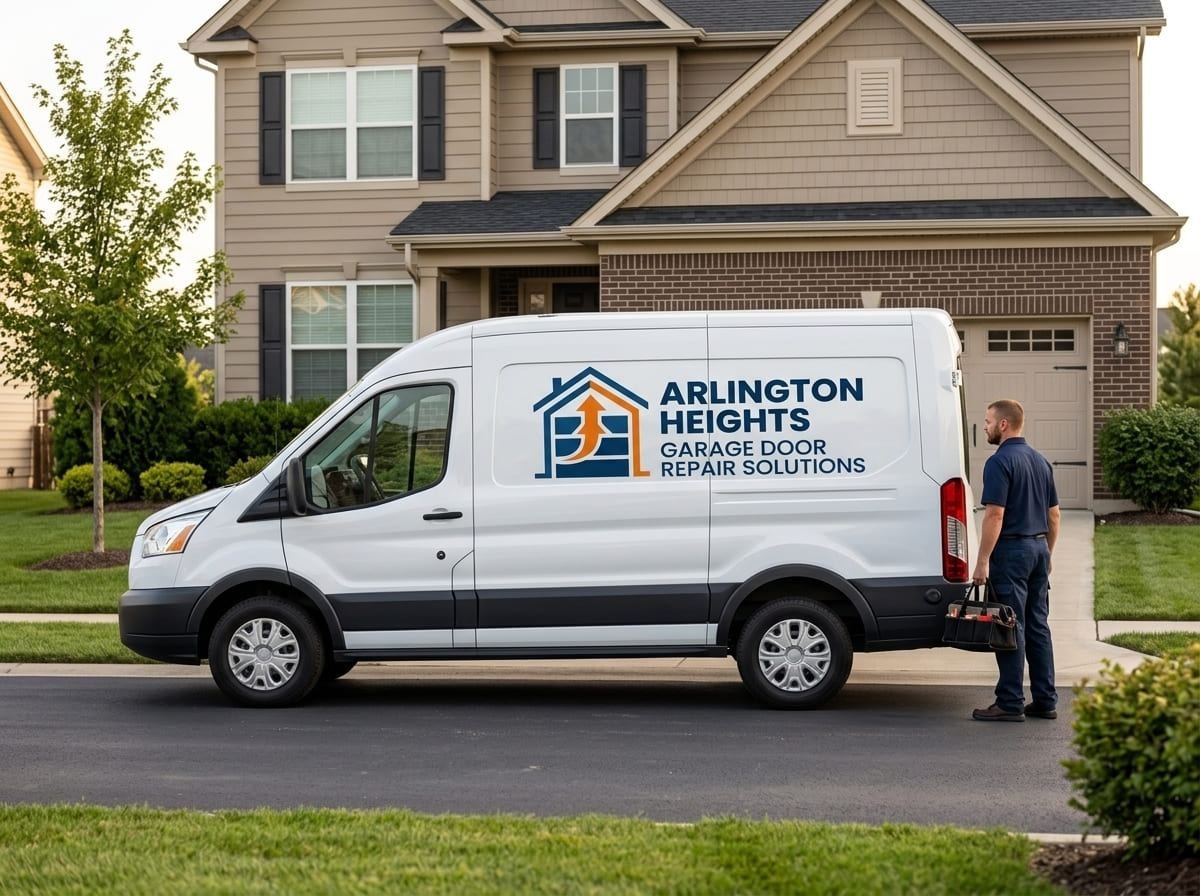
What we actually find on a fifty-year-old garage
Six things turn up again and again, none of them on the homeowner’s list when they call.
- Lag bolts loose in dried-out jamb timber. Fifty years of seasonal movement leaves track brackets working in enlarged holes. The door shifts under load and the noise gets blamed on the rollers.
- Track corroded at floor level. The bottom eighteen inches of vertical track sits in the meltwater and road salt coming off the car all winter, so that is where it rusts through first. The rest can look fine.
- Bottom sections rusted from the inside out. Steel bottom rails hold water inside the section. By the time it shows through the skin, the rail is gone.
- Wood doors that have gained weight. Wood absorbs moisture over decades and gets measurably heavier. The springs were wound for the door as delivered, so it no longer balances, and every cycle since has overloaded the counterbalance.
- Openers older than the photo-eye rule. Units predating 1 January 1993, when the CPSC final rule required an external entrapment protection device, are still in service here. No sensors, no brackets, one button on the wall.
- Headroom eaten after the fact. Somebody drywalled the ceiling in 1994, somebody else hung a storage platform in 2011, and now there is not enough clearance for standard track. Hence low-headroom hardware on some quotes.
Where these garages are
The village wears its build dates on its street plan. Catino Estates, late 1960s into the 1970s, around 250 homes of 2,000 to 3,200 square feet, is exactly the profile: large attached garages, wide openings, original-spec hardware. Surrey Ridge on the south side is 1960s–70s with no HOA, so doors there have been replaced piecemeal and no two houses match. Westgate, Scarsdale and Scarsdale Estates east of Arlington Heights Road are mid-century and close-in. Ivy Hill near Lake Arlington, Stonegate, Pioneer Park and Berkley Square sit in the same broad era. Terramere, north of Dundee, is the outlier: early 1980s, a decade younger and a grade better.
All of that is a generalization about a neighborhood, not a diagnosis of your house. We measure before saying anything definite.
What to spend money on first
On a fifty-year-old door with a limited budget, the order matters more than the total.
-
Anything holding weight
Springs, cables, bottom brackets and the lag bolts holding track to jamb. These are the safety items and the ones that fail suddenly. If the jamb timber is soft, the fix is new backing, not longer screws. Spring work and cable work come first.
-
Entrapment protection
If the opener has no photo eyes, that is the next dollar, ahead of anything cosmetic. A pre-1993 unit cannot usually be retrofitted, so this means a new opener. Run the 30-day safety check either way.
-
Rollers and bearings
Nylon rollers on sealed bearings and new end bearing plates transform how an old door runs, for a fraction of the cost of a door. Half our noise complaints end here.
-
Track, seals and weatherstripping
Replace corroded lower track rather than patching it, and fit a new astragal and perimeter seal. That is what keeps water out of the bottom rail here. See track repair.
-
The door itself, last
Sections are the expensive part and, unless one is holed or crushed, usually the least urgent. One bad panel on an otherwise sound door is a panel replacement, not a new door.
When to stop repairing
There is a point where spending on an old door stops making sense, and we would rather say so than keep billing. Stop when the bottom rail has rusted through and will no longer hold a bracket. Stop when a wood door has taken on enough water that rehanging it needs heavier springs and stiffer hardware than the frame was built for. Stop when sections are out of square and the door only stays in the track because it is being persuaded.
At that point replacing the door is the honest recommendation. One rule goes with it: do not reuse the old track. DASMA is explicit in its consumer safety guidance that track compatibility depends on door thickness, weight and headroom, and a new door hung on 1974 track is a callback waiting to happen. If resale is your reason for doing it, read our skeptical look at the 282% return figure before you set a budget.
Permits are worth a sentence too. The Village publishes no standalone garage door permit packet, so we confirm the position with Building & Life Safety on jobs that need it, and we are registered to work in the village. Full detail in our article on garage door permits here.

We work across the village and the suburbs around it, including Mount Prospect, where the 1940s, 1950s and 1960s are about 60% of the housing, and Prospect Heights, mostly 1960s and 1970s. The full list is on our service areas page. For an honest read on what your door has left in it, get in touch.

Dale Whitmore
Owner & Lead Technician
Runs this business from 60004 and has been in and out of these garages since the 1990s. He can usually date a door from the driveway.
Straight answers
Questions about older Arlington Heights garages
How long should a garage door last in this climate?
The sections often outlive everything else, which is why so many 1970s doors are still hanging. Springs are consumed by cycles rather than years, openers rarely pass twenty, and rollers, bearings and seals need replacing several times over the life of a door. A fifty-year-old door is not automatically finished, but it will have had rounds of work.
Is a 1970s opening a standard size?
Often, but not reliably. Sixteen by seven and eight by seven are common in 1960s and 1970s builds here, while pre-1960 detached garages throw up narrower, shorter openings. Headroom is the bigger variable, especially where a ceiling was finished or a platform added later. We measure opening, side room and headroom before quoting.
My wood door still looks fine. Do I need to worry?
Check the balance rather than the paint. Wood absorbs moisture over decades and gets heavier, and the springs were sized for the door as it left the factory. Pull the release with the door closed, lift to waist height, let go. If it will not hold, the counterbalance no longer matches the door.
Which part of Arlington Heights has the oldest doors?
The 60005 side, generally. South Arlington Heights skews older in the ACS data, with the 1960s, 1950s and 1940s as its largest cohorts, against a broader spread in 60004 to the north. That means more single-bay openings, less headroom and more openers predating the 1993 photo-eye requirement south of the center.
Is it worth replacing hardware on a door I plan to replace in a few years?
Rollers, bearings and seals, yes: they are cheap, they reduce wear on everything else and they make the door usable meanwhile. Springs, yes, because they are a safety item. New track, no, since it will not transfer. Tell us your timeline and we will scope the work to match.
Fifty-year-old door? Get an honest assessment.
We will tell you what it needs now, what can wait, and what is not worth doing.