
Bonded-core sections · DASMA TDS #185
Your Insulated Garage Door Is Bowing in Winter. It’s Probably Not a Defect
You stand in the garage on a January evening and the door is not flat. The middle has pulled away from the stop, or bulged toward you, and light shows at one corner. Before you call the manufacturer, read what the industry’s own technical sheet says about it.

What you are looking at
Thermal bowing. An insulated section is a sandwich: steel skin outside, bonded foam core, steel or vinyl skin inside. In winter the outer skin sits at outdoor temperature and the inner skin at garage temperature, and the two are not the same length. The panel curves toward whichever side is warmer.
It looks alarming because a garage door is a large flat object and the eye is good at spotting a curve in one. It is also temporary, reversible, and expected by the people who make the door.
Why a bonded-core section bows
DASMA publishes a technical data sheet on precisely this: TDS #185, Thermal Bowing of Garage Doors with Bonded Core Sections. Its central statement leaves no room for interpretation:
DASMA, TDS #185
“All insulated panels will exhibit some thermal bowing when subjected to a temperature difference from one side of the insulated panel to the other.”
Not some panels. Not poorly made ones. All of them. The foam core bonds the two skins together so they cannot slide past each other, and when one is expanding while the other contracts, the only way the assembly can resolve the difference is to curve toward the warmer skin.
Scale matters. DASMA notes that on a 20-foot-wide door, unreinforced thermal bow “could exceed several inches.” The document is equally direct about what that means commercially: thermal bowing is an inherent characteristic of insulated sections, not a product defect. It is minimized with horizontal struts across the back of the door, and it is worse on doors that are large, dark-colored, thermally broken, sitting in direct sun, with conditioned space behind them.
Why it happens here, twice a season
Read that list of aggravating factors again with a northwest suburbs house in mind. It describes two completely different days.
The hard freeze
An attached garage here is rarely at outdoor temperature. It shares a wall and a ceiling with heated space, often holds a furnace or water heater, and gains heat every time a warm car is parked inside. Even unheated, it commonly sits well above outside. Put −10 °F on the other side of the door and you have a large differential across the panel. The door bows inward.
This is a real Chicago condition, not a hypothetical. O’Hare’s 1991–2020 January normals give an average low of 18.8 °F, and the 2019 polar vortex took lows near −23 °F. If your garage is deliberately conditioned — a workshop, a gym, a home office — the differential is bigger again, which the Department of Energy’s guidance on attached garages is worth reading alongside.
The bright cold February afternoon
The second surprises people. Air temperature 20 °F, clear sky, low winter sun striking a south- or west-facing door. A dark steel skin in direct sun runs far above ambient while the inside face stays at garage temperature. Now the outside is the warm skin and the door bows outward, away from the stop molding. Homeowners notice because it stops sealing at the top corners on an afternoon that is not especially cold.
Bow or damage: how to tell
This is the part worth getting right, because the two need completely different responses.
| Sign | Thermal bow | Actual damage |
|---|---|---|
| Shape | A smooth, symmetrical curve across the width | A local kink, crease or dent |
| Behavior over time | Changes with the weather; returns when temperatures equalize | Permanent, identical in July |
| Where it is worst | Center of the widest sections | Wherever it was struck, or at a hinge or end stile |
| Hardware | Struts and hinges straight and sound | Bent strut, cracked section, elongated hinge holes, twisted end stile |
| Sound | Quiet, or a soft pop as the panel releases | Grinding, banging, or a roller riding out of the track |
The single best test costs nothing: photograph the door from the same spot on a cold morning and again on a mild afternoon in April. If the curve has gone, it was thermal bow. If it is identical, something is bent and you want a look at the section and its hardware.
What a bowed door does to the system
Inherent does not mean harmless. A door that is not flat interferes with three things.
It trips the opener. A bowed panel dragging on the stop molding or binding at the top of travel raises the force the operator has to apply. Under 16 CFR 1211 and UL 325, a residential operator must reverse on obstruction, so it reads the extra resistance as an obstruction and backs off. The door reverses a foot from closed and the homeowner blames the opener. The opener is behaving correctly.
It catches on the stop molding. A door bowing outward can foul the exterior stop on the way past, which scuffs paint at first and eventually pushes a top roller toward the edge of the track. That is how a bow becomes an off-track door.
It stops sealing. A bow at the bottom lifts the astragal off the slab in the middle, or leaves corner gaps. You get a draft, blowing snow, and meltwater sitting where it freezes overnight, which feeds straight into the January spring failure problem.
What can actually be done
Four things, in the order we usually do them.
Add or upgrade horizontal struts
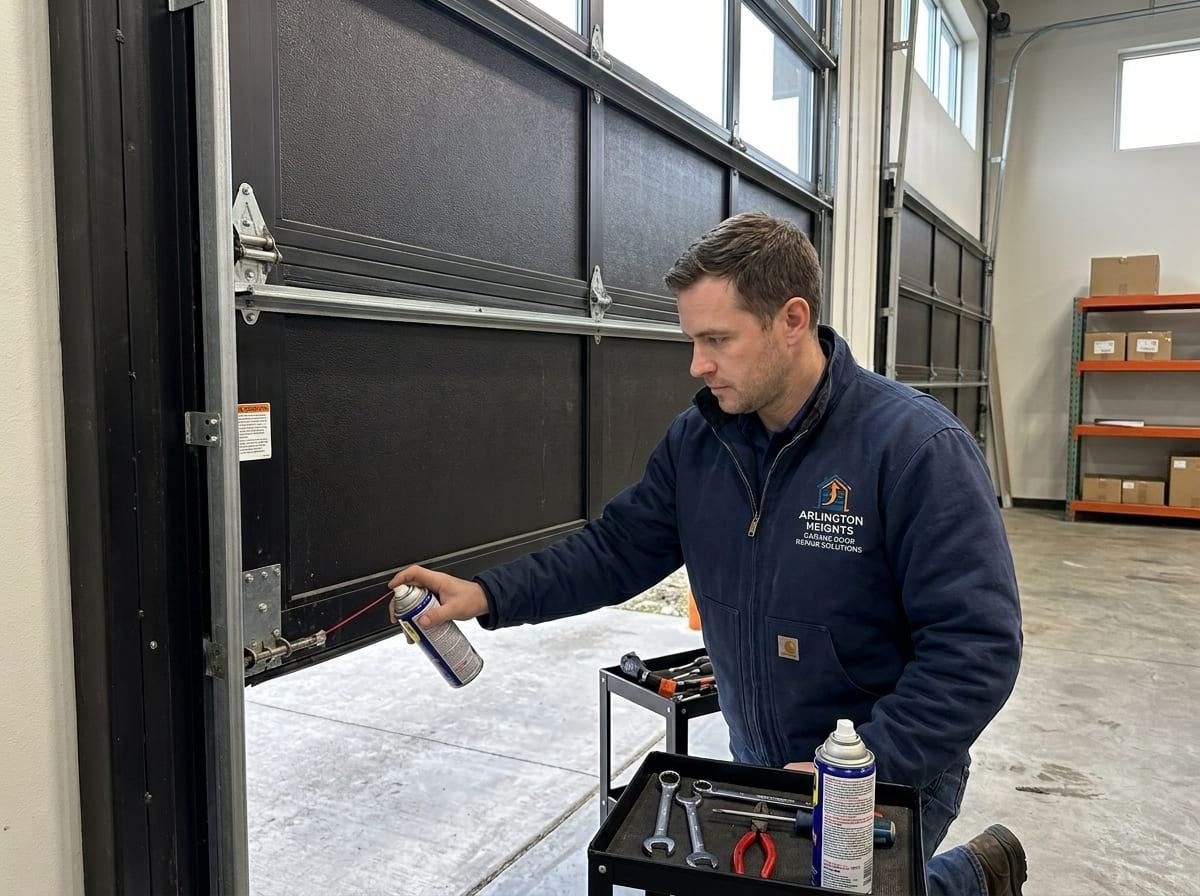
This is DASMA’s own remedy. A strut is a formed steel channel running the full width across the back of a section, and it resists the curve directly. Wide doors, and top sections carrying an opener arm, benefit most. Adding a strut to a section that never had one is a straightforward job on most doors.
Check and reset travel limits and force settings
Once the door is flatter, the operator needs to relearn it. Setting force to brute-force past a bow is the wrong answer and defeats the entrapment protection you are legally required to have.
Adjust the bottom seal and stop molding
A slightly deeper astragal, or stop molding reset to follow the door’s real plane rather than the theoretical one, closes the gaps a residual bow leaves behind.
Check the rest of the geometry
Bowing exaggerates every other misalignment, so track spacing, hinge condition and roller wear get inspected at the same visit. A flat door in a crooked track is no better off.
Specifying properly at replacement
Buying a new door, three decisions reduce bow before it starts: fewer wide unbraced sections, a lighter exterior color on a south-facing elevation, and struts specified up front rather than added later.
While you are comparing doors, ignore the number most salespeople lead with. DASMA is explicit that section-only R-value should not be used for garage door assemblies — it describes a slab of material, not a door. The meaningful figure is U-factor, tested per ANSI/DASMA 105 on a complete installed door including section joints, hardware and perimeter, and TDS #163 says it “provides the highest degree of confidence when evaluating and comparing thermal performance.” Lower is better: a door at 0.20 is twice as efficient as one at 0.40. We go into it properly in R-value versus U-factor.
There is a connection between the two topics. A thermally broken door is better insulated and therefore holds a larger temperature difference across the panel, which is exactly the condition that produces bow. Better thermal performance and more thermal bowing arrive together, which is why struts matter more on the good doors, not less.
When it genuinely is a defect
Sometimes it is worth pursuing with the manufacturer, and it is worth knowing where that line sits.
- The bow does not relax. A section that stays curved through a mild spring has taken a permanent set, and that is not what TDS #185 describes.
- Delamination. If the skin has separated from the foam core — tap it and listen for a hollow, drummy patch — the bond has failed and the section is not performing as built.
- The door was supplied without the struts its own installation instructions call for. That is a specification failure, and it usually sits with whoever installed it rather than with the factory.
- Bow far beyond what the width warrants. A 9-foot single door with a dramatic curve is behaving differently from a 20-foot double.
Photograph it in cold weather and again in mild, note the outdoor temperature each time, and keep the paperwork. That evidence turns a phone call into a claim. We will document a door for a homeowner in Buffalo Grove or Schaumburg whether or not the remedy is work for us, and if nothing is wrong, we will say so.

Dale Whitmore
Owner & Lead Technician
Founded this business in 2011 and has spent thirty years hanging and servicing sectional doors. Adds more struts than most installers, and has never regretted one.
Straight answers
Thermal bowing questions
Is thermal bowing covered by my garage door warranty?
Usually not, and manufacturers are within their rights there. DASMA TDS #185 states that thermal bowing is an inherent characteristic of insulated bonded-core sections rather than a product defect. What may be covered is a section that stays bowed after temperatures equalize, or a skin that has delaminated from the core.
How much bow is normal?
It scales with width and with the temperature difference. DASMA notes that on a 20-foot-wide door, unreinforced thermal bow could exceed several inches. A well-strutted 16-foot door in a Chicago cold snap typically shows far less than that, and the number that matters is whether it returns flat when the weather turns.
Will adding struts stop it completely?
No, and any company promising that is overselling. Struts are what DASMA identifies as the means of minimizing thermal bow, and on most doors they reduce it enough that the seal and the opener stop noticing. The underlying physics does not go away.
My door reverses just before it closes on cold mornings. Is that the bow?
It can be. A bowed section binding on the stop molding raises resistance, and UL 325 requires the operator to reverse on obstruction, so it reads that as something in the way. Check the bottom seal is not frozen to the slab first, then have the travel limits, force settings and door plane looked at together.
Does a darker door really bow more?
In direct sun, yes. DASMA lists dark color among the factors that worsen thermal bowing, alongside large size, thermal breaks and conditioned space behind the door. A dark south-facing steel skin can run well above air temperature on a clear February afternoon, which reverses the direction of the bow.
Not sure whether it is bow or damage?
Send a photo taken from one end of the door, tell us the outdoor temperature, and we will give you a straight answer before anyone visits.